



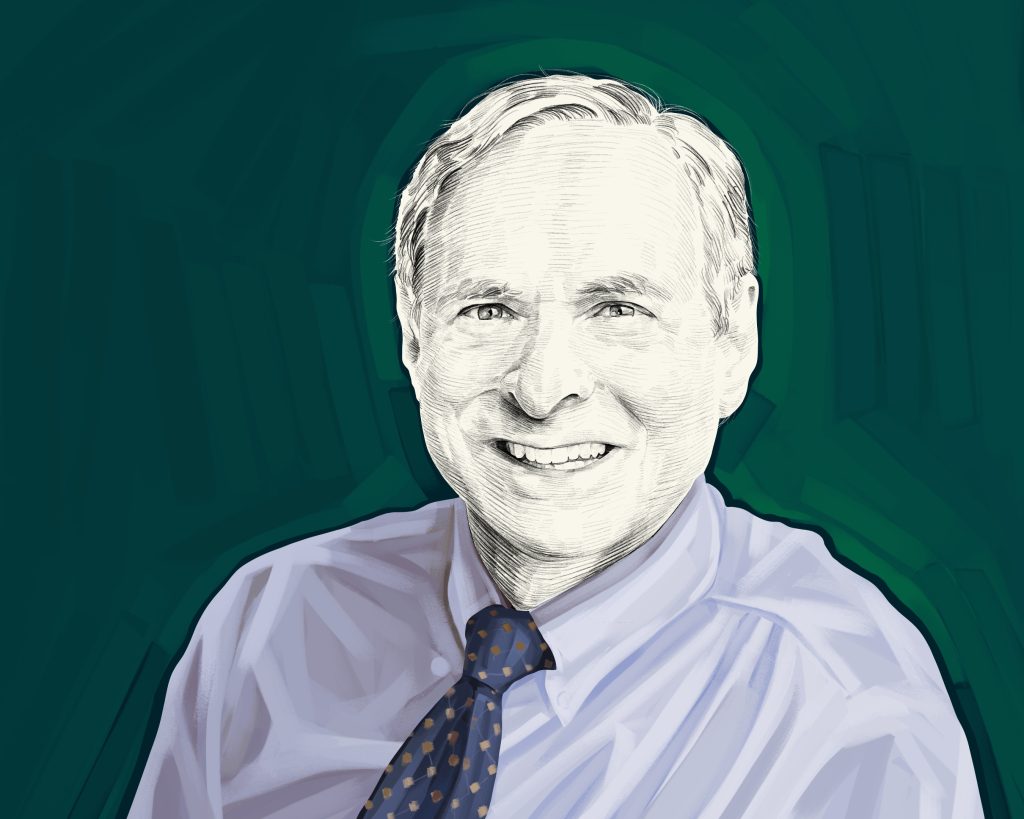
“I was taught in college and medical school that the mind is what the brain does and all our thoughts and feelings and perceptions are all created by the brain. And I cannot believe that anymore. I’ve seen people whose brains were either offline or severely impaired telling me they had the most elaborate experience they’ve ever had. So I’m inclined to think that the mind is something else and the brain filters it.”
— Dr. Bruce Greyson
Bruce Greyson, M.D. (brucegreyson.com), is the Chester F. Carlson Professor Emeritus of Psychiatry & Neurobehavioral Sciences and Director Emeritus of the Division of Perceptual Studies at The University of Virginia. He is also a Distinguished Life Fellow of the American Psychiatric Association and one of the founders of the International Association for Near-Death Studies.
Dr. Greyson’s research for the past half century has focused on the aftereffects and implications of near-death experiences and has resulted in more than 100 presentations to national and international scientific conferences, more than 150 publications in academic medical and psychological journals, 50 book chapters, and numerous research grants.
He is a co-author of Irreducible Mind: Toward a Psychology for the 21st Century; co-editor of The Near-Death Experience: Problems, Prospects, Perspectives and of The Handbook of Near-Death Experiences: Thirty Years of Investigation; and author of After: A Doctor Explores What Near-Death Experiences Reveal about Life and Beyond.
Please enjoy!
This episode is brought to you by Seed’s DS-01® Daily Synbiotic broad spectrum 24-strain probiotic + prebiotic, Helix Sleep premium mattresses, and Wealthfront high-yield cash account.
Listen to the episode on Apple Podcasts, Spotify, Overcast, Podcast Addict, Pocket Casts, Castbox, YouTube Music, Amazon Music, Audible, or on your favorite podcast platform. Watch the interview on YouTube.
The transcript of this episode can be found here. Transcripts of all episodes can be found here.



This episode is brought to you by Seed’s DS-01 Daily Synbiotic! Seed’s DS-01 was recommended to me more than a year ago by a PhD microbiologist, so I started using it well before their team ever reached out to me. After incorporating two capsules of Seed’s DS-01 into my morning routine, I have noticed improved digestion, skin tone, and overall health. It’s a 2-in-1 probiotic and prebiotic formulated with 24 clinically and scientifically studied strains that have systemic benefits in and beyond the gut. And now, you can get 20% off your first month of DS-01 with code 20TIM.
This episode is brought to you by Helix Sleep! Helix was selected as the best overall mattress of 2025 by Forbes and Wired magazines and best in category by Good Housekeeping, GQ, and many others. With Helix, there’s a specific mattress to meet each and every body’s unique comfort needs. Just take their quiz—only two minutes to complete—that matches your body type and sleep preferences to the perfect mattress for you. They have a 10-year warranty, and you get to try it out for a hundred nights, risk-free. They’ll even pick it up from you if you don’t love it. And now, Helix is offering listeners 27% off all mattress orders for a limited time at HelixSleep.com/Tim.
This episode is brought to you by Wealthfront! Wealthfront is a financial services platform that offers services to help you save and invest your money. Right now, your cash can earn 3.30% APY—that’s the Annual Percentage Yield—with the Wealthfront Cash Account from its network of program banks. That’s 8 times more interest than a typical savings account at a bank, according to FDIC.gov as of 1/22/2026 (Wealthfront’s 3.30% APY vs. 0.39% average savings rate). Right now, for a limited time, Wealthfront is offering new clients that use my sign-up link an additional 0.75% boost over the base rate for three months, meaning you can get up to 4.05% APY, limited to $150,000 in deposits. Terms & Conditions apply. Visit Wealthfront.com/Tim to get started.
The Cash Account, which is not a deposit account, is offered by Wealthfront Brokerage LLC (“WFB”), member FINRA/SIPC. Wealthfront Brokerage is not a bank. The 3.30% Base APY on cash deposits is as of January 30, 2026, is representative, subject to change, and requires no minimum balance. The overall boosted rate is subject to change if the base rate decreases during the three-month promotional period. Tim Ferriss, who’s not a client, receives cash compensation from Wealthfront Brokerage LLC for advertising and holds a non-controlling equity interest in the corporate parent of Wealthfront Brokerage LLC, which creates an incentive that results in a conflict of interest. Tim expresses his own opinions and Wealthfront does not endorse, sponsor, or promote them. This ad may not reflect the experience of other Cash Account clients, and similar outcomes are not guaranteed. Investment advisory services are provided by Wealthfront Advisers LLC, an SEC-registered investment adviser. Securities investments: not bank deposits, not bank-guaranteed or FDIC-insured, and may lose value. See full disclosures here.
Want to hear another episode that ponders the nature of consciousness? Have a listen to my conversation with Professor Donald Hoffman here, in which we discuss the science of consciousness, how perception may influence the physical world, the holographic model of the universe, panpsychism (and influential panpsychists), cosmological polytope, the use of hallucinogenic drugs to tap into deeper reality and interact with conscious agents, QBism, the probability of zero that humans evolved to see reality in full, and much more wild stuff.
What was your favorite quote or lesson from this episode? Please let me know in the comments.
SELECTED LINKS FROM THE EPISODE
- Connect with Dr. Bruce Greyson:
- After: A Doctor Explores What Near-Death Experiences Reveal About Life and Beyond by Bruce Greyson | Amazon
- Division of Perceptual Studies | University of Virginia School of Medicine
- Near-Death Experience (NDE) | Wikipedia
- Defining Near-Death Experiences by Bruce Greyson | Mortality
- Life After Death: NDE Survivor Who ‘Floated’ in Coma Recalls ‘Red Stain on Doctor’s Tie’ | Daily Express
- Life After Life: The Investigation of a Phenomenon — Survival of Bodily Death by Raymond A. Moody, Jr. | Amazon
- The Handbook of Near-Death Experiences: Thirty Years of Investigation by Janice Miner Holden, Bruce Greyson, and Debbie James | Amazon
- The Near-Death Experience Content (NDE-C) Scale: Development and Psychometric Validation | Consciousness and Cognition
- Greyson NDE Scale | IANDS
- Cargo Cult Science: Richard Feynman’s 1974 Caltech Graduation Address on Integrity | The Marginalian
- Richard Feynman Teaches You the Scientific Method | Farnam Street
- ‘‘False Positive’’ Claims of Near-Death Experiences and ‘‘False Negative’’ Denials of Near-Death Experiences by Bruce Greyson | Death Studies
- Jim Ryan Talks Near-Death Experiences with Dr. Bruce Greyson | Inside UVA
- MG MGB | Wikipedia
- Seeing Dead People Not Known to Have Died: “Peak in Darien” Experiences by Bruce Greyson | Anthropology and Humanism
- The Peak In Darien: With Some Other Inquiries Touching Concerns of the Soul and the Body, An Octave of Essays by Frances Power Cobbe | Amazon
- Quantifying the Incredible | UVA Health Foundation
- Physician Explains Why He Takes Near-Death Experiences Seriously | Mind Matters
- Hume’s Sceptical Materialism | Cambridge Core
- Midazolam Injection (Versed) Uses and Side Effects | Cleveland Clinic
- Near-Death Experiences — Dealing with Skepticism (Panel Discussion) | IANDS
- Covert Cognition: My So-Called Near-Death Experience | Skeptical Inquirer
- Counter-Arguments to Lack of Oxygen-Induced NDEs? | r/NDE
- Near-Death Experiences Can ‘Totally Transform’ a Person in Seconds Says Scientist | Newsweek
- Placebos Are Getting More Effective. Drugmakers Are Desperate to Know Why. | Wired
- You Know It’s a Placebo. So Why Does It Still Work? | Wired
- Science, the Self, and Survival after Death: Selected Writings of Ian Stevenson | Division of Perceptual Studies
- Near-Death Experiences in India: A Preliminary Report by Satwant Pasricha and Ian Stevenson | The Journal of Nervous and Mental Disease
- Life after Death: Near-Death Experiences of Hindus | Sanskriti
- Near-Death Experience in Indian Religions. Encountering Yama by Shona Stockton (Dissertation) | University of Chester
- Near-Death Experiences and Spirituality by Bruce Greyson | Zygon
- Can Near-Death Experiences Prove the Afterlife? | Big Think
- Enhanced Interplay of Neuronal Coherence and Coupling in the Dying Human Brain | Frontiers in Neuroscience
- Surge of Neurophysiological Coherence and Connectivity in the Dying Brain | PNAS
- AWAreness During REsuscitation — II: A Multi-Center Study of Consciousness and Awareness in Cardiac Arrest | Resuscitation
- Near-Death Experiences: Implications for Clinical Practice | Health Forum Online
- Flatliners | Prime Video
- Psychedelics May Give the Living a Glimpse Into Near-Death States | The New York Times
- Psychedelic Drugs Can Be Almost as Life Altering as Near-Death Experiences | The Conversation
- Long-Term Follow-up of Psilocybin-Assisted Psychotherapy for Psychiatric and Existential Distress in Patients with Life-Threatening Cancer | Journal of Psychopharmacology
- Out-of-Body Experience | Wikipedia
- Salvinorin A | Wikipedia
- Aldous Huxley: The Reducing Valve Theory | Nexus Void
- De Morbo Sacro by Hippocrates | The Perseus Catalog
- Marcus Raichle on the Default Mode Network | VPRO Labyrint TV
- Thalamocortical Radiations | Wikipedia
- Brain Area Thought to Impart Consciousness Behaves Instead Like an Internet Router | University of Maryland School of Medicine
- The Biggest Twin Registry in the UK for the Study of Ageing Related Diseases | TwinsUK
- Twin Telepathy? | r/Twins
- What is CRISPR? | New Scientist
- What is Bully Whippet Syndrome? | DDC Pets & Vets
- Belgian Blue | Beef2Live
- Using Virtual Reality to Explore the Neuroscience of Out-of-Body Experiences | CNS
- Scientists Induce Out-of-Body Experience | MIT Technology Review
- Voluntary Out-of-Body Experience: An fMRI Study | Frontiers in Neuroscience
- One Million Dollar Paranormal Challenge | Wikipedia
- Project Nim | Prime Video
- Terminal Lucidity: What We Know and What We’re Learning | Healthline
- Why Time Stops at Near Death | Psychology Today
- Auditory Hallucinations Following Near-Death Experiences | Journal of Humanistic Psychology
- Irreducible Mind: Toward a Psychology for the 21st Century by Edward Kelly, Emily Williams Kelly, Adam Crabtree, Alan Gauld, Michael Grosso, and Bruce Greyson | Amazon
- Irreducible Mind | Wikipedia
- 5% Have Had a Near-Death Experience — And They Say It Made Life Worth Living | New York Post
SHOW NOTES
- [06:00] Bruce’s scientific upbringing and his attraction to psychiatry.
- [09:03] Bruce’s first encounter with a near-death experience (NDE) that changed everything.
- [15:37] Development of the NDE scale and its characteristics.
- [19:59] Challenges in studying NDEs and distinguishing genuine experiences.
- [21:31] Examples of NDEs and out-of-body experiences verified by third parties.
- [29:16] Attempts to explain NDEs through biological mechanisms.
- [33:58] Does the manner of someone’s misadventure have a bearing on their NDE?
- [36:54] Prevalence and consistency of NDEs across cultures and time.
- [40:42] How new tools may deliver scientifically viable NDE evidence.
- [51:23] What’s happening when people report seeing dead loved ones during NDEs?
- [52:49] What can research tell us about the practical applications of NDEs?
- [52:49] Are there reliable ways to simulate an NDE-like state?
- [59:35] What’s really happening during an out-of-body experience?
- [01:04:43] Mind vs. brain.
- [01:09:42] Bruce’s career challenges and motivations for studying NDEs when few would.
- [01:12:36] Can studying twins find a genetic component to NDE susceptibility?
- [01:16:24] The difficulties of replicating out-of-body experiences in controlled settings.
- [01:20:58] The mysteries of terminal lucidity phenomenon.
- [01:23:01] The concept of time in NDEs.
- [01:25:01] Auditory hallucinations after NDEs.
- [01:26:33] Researchers who demonstrate open-mindedness and rigorous skepticism in NDE studies.
- [01:28:07] The irreducible mind concept.
- [01:29:08] Want to read Bruce’s books? Start with After.
- [01:29:49] Common characteristics and after-effects of NDEs.
- [01:30:37] Parting thoughts.
MORE DR. BRUCE GREYSON QUOTES FROM THE INTERVIEW
“If you study things that we pretty much understand already, you can make little inroads here and there about fine points. If you really want to make some impact, you need to study things we don’t understand at all.”
— Dr. Bruce Greyson
“I started out as a materialist skeptic. After 50 years, I’m still skeptical, but I’m no longer a materialist. I think that’s a dead end when it comes to explaining near-death experiences and other phenomena like this.”
— Dr. Bruce Greyson
“I’m not a philosopher. I’m an empiricist. And when people say to me, as many do, ‘If you have this non-physical mind, how does it interact with a physical brain?’ And I have no idea. On the other hand, if you take a materialistic perspective and say, ‘How does the brain, the chemical and electrical changes in the brain, create an abstract thought?,’ we have no idea about that either.”
— Dr. Bruce Greyson
“Whether you’re an empiricist, a materialist, or not, we can’t explain how thoughts arise and how they get processed to us. What we do know is that all our experiences are filtered to us through the brain.”
— Dr. Bruce Greyson
“I was taught in college and medical school that the mind is what the brain does and all our thoughts and feelings and perceptions are all created by the brain. And I cannot believe that anymore. I’ve seen people whose brains were either offline or severely impaired telling me they had the most elaborate experience they’ve ever had. So I’m inclined to think that the mind is something else and the brain filters it.”
— Dr. Bruce Greyson
“About five percent of the general population—or one to every 20 people—has had a near-death experience. Secondly, they are not associated in any way with mental illness. People who are perfectly normal have these NDEs in abnormal situations that can happen to anybody.”
— Dr. Bruce Greyson
“The more I learned about [NDEs], the harder they seemed to understand. So I’ve gotten more comfortable with not knowing all the answers.”
— Dr. Bruce Greyson
“Right now, people are listening to us and there’s electrical activity in parts of their brain that process hearing. It always happens when they’re hearing us. This part of the brain always lights up. That doesn’t mean that electrical activity is causing our voices; it’s just a reflection of it. So when you find these physiological concomitants of a near-death experience, you’re finding perhaps the mechanism for it, but not the cause of it.”
— Dr. Bruce Greyson
“Most people who study near-death experiences, whether they’re spiritualists or materialists or neuropsychologist or philosophers, they agree on the phenomena, they don’t agree on the interpretation of it, of what’s causing it and what its ultimate meaning is.”
— Dr. Bruce Greyson
“Many near-death experiencers have tried drugs afterwards to try to replicate the experience, and they universally tell me it is not the same thing. One person told me, ‘When I was on psilocybin, I saw Heaven. When I was in my near-death experience, I was in Heaven.’”
— Dr. Bruce Greyson

Comment Rules: Remember what Fonzie was like? Cool. That's how we're gonna be — cool. Critical is fine, but if you're rude, we'll delete your stuff. Please do not put your URL in the comment text and please use your PERSONAL name or initials and not your business name, as the latter comes off like spam. Have fun and thanks for adding to the conversation! (Thanks to Brian Oberkirch for the inspiration.)
Yesterday morning I was coming to the end of The Tibetan Book of Living and Dying by Sogyal Rinpoche. In 2022, I participated in a clinical trial that used psilocybin and have been working on a book about the experience. Throughout the Tibetan book I've been making notes about the similarities of the experience of death and the profound psychedelic experience I had (visiting the dead, being filled with light, conversing with a divine presence–this coming from a former atheist/ agnostic). The two trips were profoundly healing. Then later yesterday, I listened to your conversation with Dr. Greyson…he explains quite clearly that they are not the same–the NDE and the psychedelic experience–but there there can be some similarities. More than anything, my profound experiences in the clinical trial reduced my fear of death, as I believe it does for most people who experience NDE. Anyway, the synchronicity of reading and thinking about this in the morning and then hearing your podcast, my go-to podcast, was a delight. Thanks to Dr. Greyson, and to you Tim!
Tim, I really appreciated that your guest was a scientist/physician/clinician, and I loved that you asked what research/studies he would like to see funded. Thank you! For similar content, I think a part 2 with Dr. Martine Rothblatt and/or Dr. Nolan Williams would be fantastic. For something slightly different, I’d love to hear from more scientists working on climate-related research. Food for thought!
Hey Tim! This was such an insightful read! Dr. Bruce Greyson's take on near-death experiences really adds a grounded perspective to something so mysterious. I love how he emphasizes the transformative impact rather than purely focusing on the event itself. It’s refreshing to see this topic explored through a scientific lens without losing the awe of these profound experiences. Have you come across other experts in the field who bring this same mix of curiosity and academic rigor? Also, it was fascinating to see how these experiences often inspire deep life changes for those who have them. Dr. Greyson’s findings on the lasting effects on personal values and fears are truly inspiring. The concept of “noetic” experiences struck me—especially how they encourage a re-evaluation of life priorities. Thanks for bringing this to our attention, Tim! This post is definitely one to bookmark.
Fascinating insights! Dr. Greyson's research on near-death experiences offers profound perspectives on life and consciousness. I’m eager to explore how these experiences shape our understanding of existence!
Tim, Long time listener, first time commenter. I have been tiptoeing around this topic of consciousness and universal connectedness over the past couple of months. Your conversation with Dr. Greyson was a helpful piece to my attempt to weave the disparate thoughts floating in my head. I am becoming more and more convinced that our bodies and brains are a form of transmitter for the universal energy that connects all living things. We only perceive a fraction of the frequency due to our limited consciousness and when we have the ability to unlock the additional capacity, similar to the NDE and psychedelic effects, we can tap into the greater connectivity. This is also, I believe, part of the effect that meditation provides. It removes the consciousness barrier and allows the benefits received. There is so much that we are unable to understand regarding the natural world that native peoples have known before us. The essence of "God" is just a finite attempt by humans to define this unifying energy.
Thank you very much Tim, and Dr. Greyson, for a great discussion on an utterly fascinating topic. I've had a few experiences related to the subject. I also remember a former co-worker and friend (long ago passed away now) telling me about her experience while having back surgery – out of her body, she watched the medical team working on her – from a point near the ceiling. I find it interesting that people who have had these experiences often speak of being at a higher point viewing their physical selves below. I could go on for hours about this too as it is such a deeply fascinating realm. Re: films: I like the way City of Angels displays the spiritual form leaving the body, and also Ghost. Our Essence is free but our brains, and life, add in barriers to block that awareness. The addition of plant medicine is a fascinating study on opening The Doors of perception! Thank you for another great podcast!
What an insightful discussion! Dr. Bruce Greyson’s exploration of near-death experiences (NDEs) is fascinating, especially his focus on the transformative effects they can have on people's lives. I find it particularly interesting how NDEs seem to lead to a shift in perspective on life, where people often report becoming more compassionate, spiritual, and focused on meaningful connections. One thing I’ve wondered about is whether the profound changes described are always due to the NDE itself or if it’s the result of the personal reflection and introspection that follows a life-threatening event. It seems that these experiences might act as a catalyst for personal growth, but could similar changes occur through other forms of intense life experiences, like trauma or extreme hardship? The connection between NDEs and the scientific/psychological explanations is also worth exploring more. While there’s undeniable personal transformation in many cases, I wonder how much of it can be attributed to brain chemistry, cultural expectations, or psychological factors during such extreme moments. I’d love to hear others' thoughts on whether they believe NDEs represent something beyond the physical, or if the stories might be interpreted differently from a psychological perspective. [Moderator: website link redacted.]
Hey Tim, This was a really interesting episode, thank you for hosting Dr. Greyson! I was wondering if you had heard of the new podcast called The Telepathy Tapes? I started listening to it a couple weeks after this episode, and some of the things I learned on each really resonated with each other. The podcast is about non-verbal autistic kids who seem to have telepathic-like abilities. Here's a link to it: https://podcasts.apple.com/us/podcast/the-telepathy-tapes/id1766382649 I would really love to get your perspective on some of the things covered in it, if true it seems like there could be an interesting path forward with someone like you becoming an "Xavier" of sorts for these kids – a school for "gifted youngsters." Thanks, Jacob