



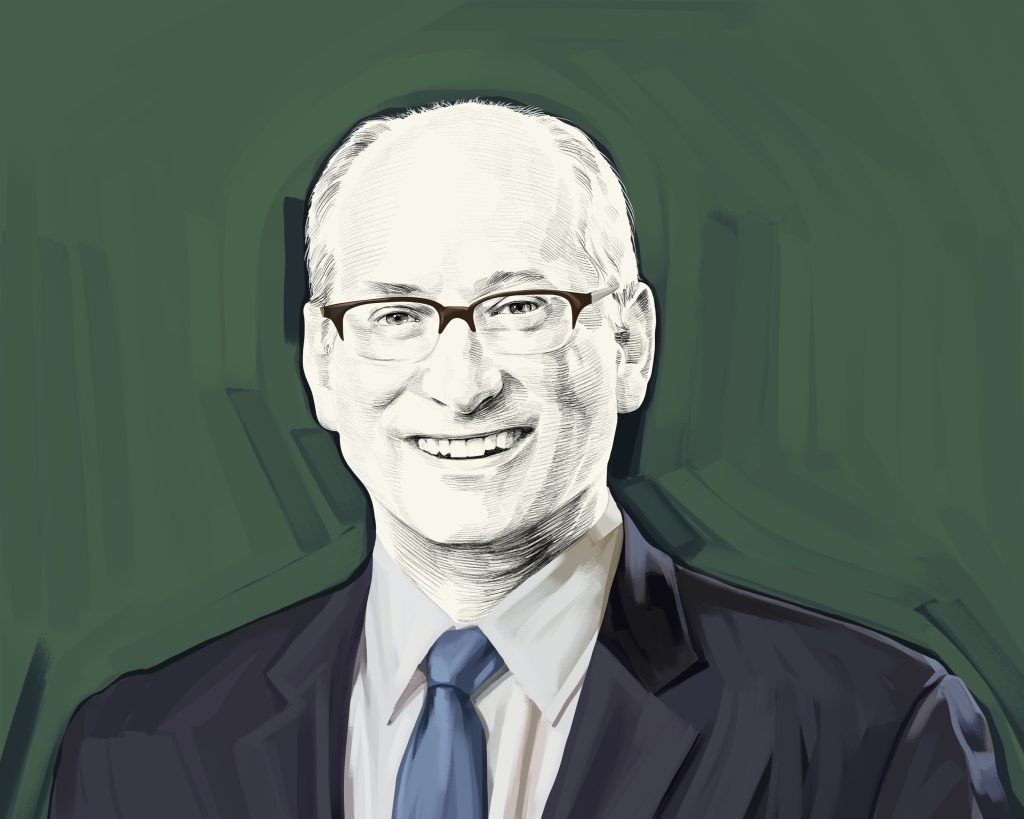
“Depression is a disorder of the spirit, if you will—the brain but also the whole body. And that’s one of the reasons why it’s one of the most disabling conditions that we have in the world.”
— Dr. John Krystal
Dr. John Krystal is the Robert L. McNeil, Jr., Professor of Translational Research; Professor of Psychiatry, Neuroscience, and Psychology; Chair of the Department of Psychiatry at Yale University; and Chief of Psychiatry and Behavioral Health at Yale-New Haven Hospital.
Dr. Krystal is a leading expert in the areas of alcoholism, post-traumatic stress disorder, schizophrenia, and depression. His work links psychopharmacology, neuroimaging, molecular genetics, and computational neuroscience to study the neurobiology and treatment of these disorders. He is best known for leading the discovery of the rapid antidepressant effects of ketamine in depressed patients.
He directs/co-directs the Yale Center for Clinical Investigation (CTSA), NIAAA Center for the Translational Neuroscience of Alcoholism, and Clinical Neuroscience Division of the National Center for PTSD (VA).
Dr. Krystal is a member of the U.S. National Academy of Medicine; co-director of the Neuroscience Forum of the U.S. National Academies of Sciences, Engineering, and Medicine; Fellow of the American Association for the Advancement of Science (AAAS); and editor of Biological Psychiatry, one of the most selective and highly cited journals in the field of psychiatric neuroscience.
He is the co-founder and Chief Scientific Advisor of Freedom Biosciences, a clinical-stage biotechnology platform developing next-generation ketamine and psychedelic therapeutics that recently emerged from stealth in August 2022.
ONE VERY IMPORTANT DISCLAIMER: I’m not a doctor, nor do I play one on the Internet. None of the content in this podcast constitutes medical advice or should be construed as a recommendation to use ketamine or psychedelics. There are psychological, physical, and sometimes legal risks with such usage. Please consult your doctor before considering anything we discuss in this episode.
Please enjoy!


This episode is brought to you by Helix Sleep! Helix was selected as the best overall mattress of 2025 by Forbes and Wired magazines and best in category by Good Housekeeping, GQ, and many others. With Helix, there’s a specific mattress to meet each and every body’s unique comfort needs. Just take their quiz—only two minutes to complete—that matches your body type and sleep preferences to the perfect mattress for you. They have a 10-year warranty, and you get to try it out for a hundred nights, risk-free. They’ll even pick it up from you if you don’t love it. And now, Helix is offering listeners 27% off all mattress orders for a limited time at HelixSleep.com/Tim.
This episode is brought to you by AG1! I get asked all the time, “If you could use only one supplement, what would it be?” My answer is usually AG1, my all-in-one nutritional insurance. I recommended it in The 4-Hour Body in 2010 and did not get paid to do so. Right now, get a FREE Welcome Kit, including Vitamin D3+K2 and AG1 Flavor Sampler, when you first subscribe. Visit DrinkAG1.com/Tim to claim this special offer today and receive your 1-year supply of Vitamin D—a vital nutrient for a strong immune system and strong bones!
Want to hear another podcast episode with someone who’s exploring the beneficial properties of mind-altering compounds? Listen to my conversation with Dr. Suresh Muthukumaraswamy, in which we discuss how ketamine differs from other psychedelics, the durability of antidepressant effects, obstacles to getting ketamine labeled as an antidepressant, avoiding another 50 years of psychedelic research darkness, where aspiring psychedelic researchers should focus their education, and much more.
What was your favorite quote or lesson from this episode? Please let me know in the comments.
SCROLL BELOW FOR LINKS AND SHOW NOTES…
SELECTED LINKS FROM THE EPISODE
- Freedom Biosciences
- John Krystal, MD | Yale School of Medicine
- A Prescription Nasal Spray | Spravato
- Interventional Psychiatry | Yale New Haven Psychiatric Hospital
- Robert Ostroff, MD Psychiatry | Yale New Haven Hospital
- Gerard Sanacora, MD,PhD Psychiatry | Yale New Haven Hospital
- Henry Krystal, Holocaust Trauma Expert, and Survivor, Dies at 90 | The New York Times
- Living With Terror, Working With Trauma: A Clinician’s Handbook: A Clinicians Handbook by Danielle Knafo et al. | Amazon
- Some Practical Thoughts on Suicide | Tim Ferriss
- Why Most People Misunderstand Depression | Arcadian Counseling
- Ketamine: A Paradigm Shift for Depression Research and Treatment | Cell
- Melancholy | Online Etymology Dictionary
- Outcome Measurement in Mental Health Services: Insights from Symptom Networks | BMC Psychiatry
- Health Insurers Still Don’t Adequately Cover Mental Health Treatment | National Alliance on Mental Illness
- ECT (Electroconvulsive Therapy): What It Is & Side Effects | Cleveland Clinic
- Rethinking Serotonin’s Role in Depression | Brain Facts
- Should People Taking MAOIs Follow a Tyramine-Free Diet? | Healthline
- From the Death of Libby Zion, Crucial Medical Reforms | The New York Times
- Ethnopharmacologic Search for Psychoactive Drugs | ESPD 50
- MAOI Contraindications Related to Ayahuasca | MAPS
- Top 10 Medical Inventions (2017): #7 Ketamine for Treatment-Resistant Depression | Cleveland Clinic Innovations
- Brain Scanning Techniques (CT, MRI, fMRI, PET, SPECT, DTI, DOT) | Cerebra
- Ptolemaic System | The Galileo Project
- Tryptophan-Depletion Challenge in Depressed Patients Treated with Desipramine or Fluoxetine: Implications for the Role of Serotonin in the Mechanism of Antidepressant Action | Biological Psychiatry
- Antidepressants ‘Work Immediately’ | Nursing Times
- Higher Serotonin 1A Binding in a Second Major Depression Cohort: Modeling and Reference Region Considerations | Biological Psychiatry
- Glutamate and GABA Systems as Targets for Novel Antidepressant and Mood-Stabilizing Treatments | Molecular Psychiatry
- A Randomized Trial of an N-Methyl-D-Aspartate Antagonist in Treatment-Resistant Major Depression | Archives of General Psychiatry
- Serotonin and Hallucinogens | Neuropsychopharmacology
- Signaling Pathways Underlying the Rapid Antidepressant Actions of Ketamine | Neuropharmacology
- Chronic Stress Alters Synaptic Terminal Structure in Hippocampus | PNAS
- Ketamine: Just Say “Neigh!” | Max E, Twitter
- WHO Recommends Against International Control of Ketamine | IDPC
- Cell Proliferation in Adult Hippocampus is Decreased by Inescapable Stress: Reversal by Fluoxetine Treatment | Neuropsychopharmacology
- mTOR (Mechanistic Target of Rapamycin) | Wikipedia
- Study of a New Schizophrenomimetic Drug — Sernyl | Archives of Neurology & Psychiatry
- Lafayette Clinic / Woodward Academy | Detroiturbex.com
- Phencyclidine/Schizophrenia: One View Toward the Past, The Other to the Future | Schizophrenia Bulletin
- Domino by Van Morrison | Amazon Music
- The Domino Effect: Ed Domino’s Early Studies of Psychoactive Drugs | Journal of Psychoactive Drugs
- Crick, Watson, and Franklin: DNA Structure | Khan Academy
- Dissociative Anesthesia: Further Pharmacologic Studies and First Clinical Experience with the Phencyclidine Derivative Cl-581 | Anesthesia & Analgesia
- Taming the Ketamine Tiger | Anesthesiology
- Specific [3H]Phencyclidine Binding in Rat Central Nervous System | PNAS
- Clozapine Uses, Dosage, and Side Effects | Drugs.com
- Activation of Glutamatergic Neurotransmission by Ketamine: A Novel Step in the Pathway from NMDA Receptor Blockade to Dopaminergic and Cognitive Disruptions Associated with the Prefrontal Cortex | Journal of Neuroscience
- The Role Of Dissociation In Ketamine’s Antidepressant Effects | Nature Communications
- Positron Emission Tomography (PET) Center | Yale School of Medicine:
- First In Vivo Evaluations Of Synaptic Density Alterations In The Brain | Neuropsychopharmacology
- Glutamate Metabolism in Major Depressive Disorder | American Journal of Psychiatry
- Synaptic Potentiation Is Critical for Rapid Antidepressant Response to Ketamine in Treatment-Resistant Major Depression | Psychiatry Research: Neuroimaging
- Medications Besides Statins for Lowering Cholesterol | GoodRx
- Ketamine vs. S-Ketamine — What’s the Difference? | Principium Psychiatry
- Samuel Wilkinson
- Cognitive Behavioral Therapy to Sustain the Antidepressant Effects of Ketamine in Treatment-Resistant Depression: A Randomized Clinical Trial | Psychotherapy and Psychosomatics
- Modulating Amygdala Activation to Traumatic Memories with a Single Ketamine Infusion | ResearchGate
- Ketamine Can Reduce Harmful Drinking by Pharmacologically Rewriting Drinking Memories | Nature Communications
- Dose-Related Effects of Ketamine for Antidepressant-Resistant Symptoms of Posttraumatic Stress Disorder in Veterans and Active Duty Military: A Double-Blind, Randomized, Placebo-Controlled Multi-Center Clinical Trial | Neuropsychopharmacology
- Bolus Definition & Meaning | Merriam-Webster
- Ketamine Infusions vs. Intramuscular Ketamine Injections | SKI
- Side Effects Mild, Brief with Single Antidepressant Dose of Intravenous Ketamine | National Institutes of Health
- Zofran Uses, Dosage, and Side Effects | Drugs.com
- Burning Man
- Psychedelic Peer Support | Zendo Project
- Pirates of the Caribbean Ride | Walt Disney World Resort
- Ketamine Addiction | Verywell Mind
- The Health Effects of the Abuse of Ketamine | ClinMed Journals
- Lord of the Rings by J.R.R. Tolkien | Amazon
- Enantiomers | Chemistry LibreTexts
- What Are the Three Types of Ketamine, and Which One Is Right for You? | Healing Maps
- Manji Develops Novel Treatment for Major Depressive Disorder | NIH Record
- R (−)-Ketamine Shows Greater Potency and Longer Lasting Antidepressant Effects than S (+)-Ketamine | Pharmacology Biochemistry and Behavior
- The Etymology of Trivia: A Place Where Three Roads Meet | Useless Etymology
- How the Drunken Monkey Hypothesis Explains Our Taste for Liquor | The Atlantic
- Inhibition of Opiate Tolerance by Non-Competitive N-Methyl-D-Aspartate Receptor Antagonists | Brain Research
- Ketamine for Chronic Pain: Risks and Benefits | British Journal of Clinical Pharmacology
- Chronic Pain Is Surprisingly Treatable — When Patients Focus on the Brain | The Washington Post
- Esmethadone: A Novel, Rapidly Effective Treatment for Depression | MGH Psychiatry News
- Salvinorin A | Wikipedia
- Naltrexone | Wikipedia
- Naltrexone in the Treatment of Alcohol Dependence | The New England Journal of Medicine
- What Is Anhedonia? | Healthline
- Legal High Craze Hits Iinternet | On Demand News
- Modulation of the Antidepressant Effects of Ketamine by the mTORC1 Inhibitor Rapamycin | Neuropsychopharmacology
- Microglia | Wikipedia
- Microglia in Neurological Diseases: A Road Map to Brain-Disease Dependent-Inflammatory Response | Frontiers in Cellular Neuroscience
- Study Confirms Rapid Antidepressant Effect of Ketamine Extends to Taiwanese Patients | PsyPost
- My Life Extension Pilgrimage to Easter Island | The Tim Ferriss Show #193
- Glial Cells | 2-Minute Neuroscience
- The Usual Suspects | Prime Video
- How Does Ketamine Work Differently from Other Psychedelics? | Psychology Today
- The Thalamus as a Monitor of Motor Outputs | The Royal Society
- Bridging the Gap? Altered Thalamocortical Connectivity in Psychotic and Psychedelic States | Frontiers in Psychiatry
- BDNF Impact on Synaptic Dynamics: Extra or Intracellular Long-Term Release Differently Regulates Cultured Hippocampal Synapses | Molecular Brain
- Vascular Endothelial Growth Factor (VEGF) | Wikipedia
- Spark: The Revolutionary New Science of Exercise and the Brain by John J. Ratey and Eric Hagerman | Amazon
- Exercise Promotes the Expression of Brain Derived Neurotrophic Factor (BDNF) Through the Action of the Ketone Body β-Hydroxybutyrate | eLife
- Dom D’Agostino on Disease Prevention, Cancer, and Living Longer | The Tim Ferriss Show #188
- R 1,3 Ethanol-Free Alcohol by Hard Ketones | KetoneAid
- Will Ketamine Help Sleep? | Healing Maps
- Exercise Linked to Improved Mental Health, but More May Not Always Be Better | Yale School of Medicine
SHOW NOTES
- [07:30] The challenges faced by John’s late father, Henry Krystal.
- [14:44] Was Henry’s work discussed around the Krystal dinner table?
- [18:10] What people frequently misunderstand about depression.
- [25:53] Why partial response and non-response occur commonly in psychiatry.
- [32:15] From the serotonin hypothesis to “what’s really exciting” about antidepression research.
- [35:08] How monoamine oxidase inhibitors reduce symptoms of depression.
- [36:41] MAOI Side effects and risks.
- [40:14] When Western medicine duplicates centuries-old shamanic wisdom.
- [43:13] How pre-imaging neuroscience of the ’80s was like Ptolemaic astronomy.
- [47:24] The reason for depression isn’t as simple as a lack of serotonin.
- [49:42] The change in perspective that illustrated ketamine as a potential therapy.
- [54:35] From first studies to overcoming skepticism.
- [1:02:39] How ketamine went from “horse tranquilizer” to antidepressant candidate.
- [1:18:46] The dose makes the difference.
- [1:23:02] What is dissociation, and is it an essential part of ketamine’s healing process?
- [1:37:32] Recommendations for optimal treatment of a close friend (frequency, duration, psychotherapy, etc.).
- [1:50:42] Reducing the potency of maladaptive memories.
- [1:56:15] Best dosage practices.
- [2:03:23] I.M. vs. I.V.
- [2:04:55] Common in-session side-effects (and remedies).
- [2:09:19] What my ketamine experience was like.
- [2:12:41] Optimal settings.
- [2:18:05] Ketamine risks.
- [2:30:22] Decreasing the opportunities for abuse and addiction.
- [2:37:28] Enantiomers: r-ketamine vs. s-ketamine
- [2:44:19] How effective is ketamine for chronic pain relief?
- [2:52:28] Why might the durability of relief outlast the presence of ketamine in the body?
- [2:56:12] What is s-methadone?
- [2:57:31] Does s-ketamine have the same abuse potential as r-ketamine?
- [3:00:46] Opiate receptor interaction with ketamine and other compounds.
- [3:05:56] What is Salvinorin A?
- [3:07:05] Exploring the ups and downs of optimizing ketamine with rapamycin.
- [3:23:28] Ketamine doesn’t have a lot in common with other psychedelics.
- [3:26:47] The effect of ketamine and other hallucinogens on the thalamus.
- [3:29:57] How important is the role of brain-derived neurotrophic factor (BDNF)?
- [3:32:20] BHB, ethanol-free alcohol, and exercise vs. depression.
- [3:35:31] Ketamine’s impact on sleep, and the potential dangers of too much exercise.
- [3:37:27] What John anticipates for the future of ketamine research and application.
- [3:41:51] Giving credit to the pioneers of the field.
- [3:43:21] Parting thoughts.
MORE GUEST QUOTES FROM THE INTERVIEW
“Depression is a disorder of the spirit, if you will—the brain, but also the whole body. And that’s one of the reasons why it’s one of the most disabling conditions that we have in the world.”
— Dr. John Krystal
“The ideal antidepressant would be a drug that acted rapidly and lasted forever. We would call that, basically, cure. And we never use the word ‘cure’ in psychiatry. We don’t even think of the idea of cure. And that’s partly because we don’t really understand the brain well enough to really know how to completely undo the changes that we see there.”
— Dr. John Krystal
PEOPLE MENTIONED
- Henry Krystal
- William Guglielmo Niederland
- Robert Jay Lifton
- John M. Dorsey
- Sigmund Freud
- Dennis S. Charney
- Claudius Ptolemy
- Claude de Montigny
- Pedro L. Delgado
- George Aghajanian
- Catherine Harmer
- Ramin Parsey
- Thomas Kuhn
- Husseini K. Manji
- Carlos Zarate
- Ronald S. Duman
- Daniel X. Freedman
- Bruce McEwen
- Eric Nestler
- Santa Claus
- Joan Luby
- Elliot D. Luby
- Edward F. Domino
- Van Morrison
- Guenter Corssen
- James Watson
- Francis Crick
- Stephen Zukin
- Suzanne Zukin
- Irina Esterlis
- Sophie E. Holmes
- Chadi Abdallah
- Allison Nugent
- Ilan Harpaz-Rotem
- Ravi K. Das
- Robert Ostroff
- Gerard Sanacora
- Smeagol
- Kenji Hashimoto
- Keith A. Trujillo
- Huda Akil
- Deepak Cyril D’Souza
- Mohini Ranganathan
- Smokey Bear
- Dominic D’Agostino
- Adam Chekroud
- Bryan Roth
- David E. Olson
- Roland R. Griffiths
- Alexander Shulgin
- Mark Geyer
- David E. Nichols
Comment Rules: Remember what Fonzie was like? Cool. That's how we're gonna be — cool. Critical is fine, but if you're rude, we'll delete your stuff. Please do not put your URL in the comment text and please use your PERSONAL name or initials and not your business name, as the latter comes off like spam. Have fun and thanks for adding to the conversation! (Thanks to Brian Oberkirch for the inspiration.)
Another great podcast episode. Thank you Tim!
Thank you Tim for making the transcripts available for the hearing impaired. I’m not sure if you get any acknowledgement of the transcripts, just wanted to Kota let you know I am very appreciative oa. Thank you sincerely.
Dr. Krystal made it sound like insurance will cover these treatments but my brief research indicates this isn’t so. Anyone know the scoop?
Dear Tim, thank you for this conversation. Talk can be such a catalyst for change and your podcast with Dr. Krystal was fantastic. Everyone's Thanksgiving dinner table offers a seating chart of disorder! As a former professional athlete who has suffered from sever depression from a young age and who is now pursuing a career in clinical counseling, I really appreciate you and the work you do.
I'm wondering why, after talking about dosage/administration routes/abuse potential, they did not discuss sublingual administration (ie rapid dissolve tables). There are so many people taking it at home – it seems deliberate to skip over that method. Clinical treatment is not-sustainable – both in cost and the difficulty with scheduling. The advantages of at-home options are immense and will surely save even more lives.
I am currently doing oral ketamine. Was wondering if one day you can do a comprehensive on that?
What should we give our dogs then? Any additional ideas would be helpful such as dose, frequency, side effects, etc. when giving it to dogs. Thanks so much!
I just can’t thank you enough for this hugely informative and educational episode!!! Although I’m a closet-science-geek and just really enjoy learning about the world around me, I’m particularly interested in ketamine assisted psychotherapy because I’ve recently decided to explore this avenue of treatment for depression and problematic addictive eating. In Canada (and especially on the East Coast), access to such innovative therapies is not only difficult but also often cost prohibitive (private clinics are the only option). The clinic I’ll be attending offers a six week program for $4725 which includes once a week treatment (2 hours of ART followed by 1.5-2 hours of KAT). After much internet research and after listening to this particular podcast, I’m feeling even more hopeful for my future. Thank you Tim and Dr. Krystal!! Renelle xx
Thank you