



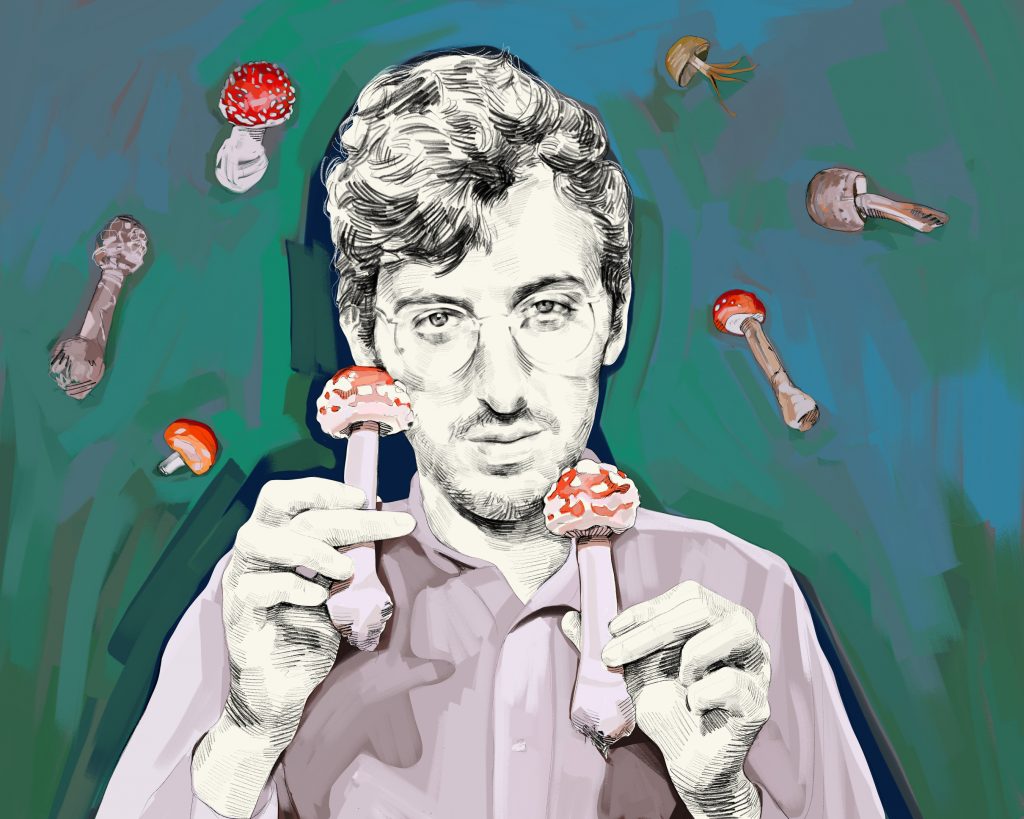
“It’s a very widespread idea that if you have personal experience with a psychoactive drug, this biases you in such a way that the research that you do is not trustworthy. But this is something that we don’t evenly apply to other disciplines. No one would ever say that an ethnomusicologist is biased because they’ve listened to music or because they enjoy music themselves or that a sports commentator is biased if they have a past as an athlete. Instead, we would say that this is something that makes him an expert who is qualified to discuss the subject.”
— Hamilton Morris
Hamilton Morris (@HamiltonMorris) is a chemist, filmmaker, and science journalist. A graduate of The New School, he conducts chemistry research at The University of the Sciences in Philadelphia.
Hamilton is the writer and director of the documentary series Hamilton’s Pharmacopeia, in which he explores the chemistry and traditions surrounding psychoactive drugs. His research has allowed him to study psychoactive plants, fungi, and chemicals, as well as the culture that surrounds them, in more than 30 countries, using an interdisciplinary approach that combines anthropology and chemistry.
Hamilton’s recent republishing of a book on Bufo alvarius has, at the time of writing, raised more than $205,000 for Parkinson’s disease research.
Please enjoy!
Listen to the episode on Apple Podcasts, Spotify, Overcast, Stitcher, Castbox, Google Podcasts, or on your favorite podcast platform. The transcript of this episode can be found here. Transcripts of all episodes can be found here.



What was your favorite quote or lesson from this episode? Please let me know in the comments.
SCROLL BELOW FOR LINKS AND SHOW NOTES…
Would you like to hear my last conversation with Hamilton Morris? Listen here as we discuss basic chemistry literacy for the layman, the value of substance-induced spiritual experiences for those who don’t consider themselves spiritual, the difference between a medicine and a poison, a cautionary tale about the unsupervised use of 5-MeO-DMT, compound harvesting sustainability, and much more.
SELECTED LINKS FROM THE EPISODE
- Connect with Hamilton Morris:
Patreon | Twitter | Instagram | Facebook
- Bufo Alvarius: The Psychedelic Toad of the Sonoran Desert by Ken Nelson
- Hamilton’s Pharmacopeia | Prime Video
- Hamilton Morris on Better Living Through Chemistry: Psychedelics, Smart Drugs, and More | The Tim Ferriss Show #337
- The Last Interview With Alexander Shulgin by Hamilton Morris and Ash Smith | Vice
- PiHKAL (Phenethylamines I Have Known and Loved): A Chemical Love Story by Alexander Shulgin and Ann Shulgin
- TiHKAL (Tryptamines I Have Known and Loved): A Continuation by Alexander Shulgin and Ann Shulgin
- This Genius Chemist Spent 50 Years Creating Psychedelic Drugs in His Home Lab…for a Good Cause | Timeline
- The War on Drugs, Explained | Vox
- MDMA (Ecstacy) | US National Library of Medicine
- MDMA-Assisted Psychotherapy | MAPS
- Introduction to the Federal Controlled Substance Analogue Act | The Vaults of Erowid
- DMT Models the Near-Death Experience | Frontiers in Psychology
- Ultra LSD | Hamilton’s Pharmacopeia
- The Nature of Drugs: History, Pharmacology, and Social Impact by Alexander Shulgin
- The World’s Largest Psychedelic Research Center | The Tim Ferriss Show #385
- What You Should Know About Capsaicin Cream | Verywell Health
- Neuropsychedelia: The Revival of Hallucinogen Research Since the Decade of the Brain by Nicolas Langlitz
- Chimpanzee Culture Wars: Rethinking Human Nature Alongside Japanese, European, and American Cultural Primatologists by Nicolas Langlitz
- UR-144 | The Drug Classroom
- The Drug of Choice for the Age of Kale: How Ayahuasca, an Ancient Amazonian Hallucinogenic Brew, Became the Latest Trend in Brooklyn and Silicon Valley | The New Yorker
- Nicotine | US National Library of Medicine
- Ibogaine | US National Library of Medicine
- 2C-D | The Vaults of Erowid
- The Man Who Mistook His Wife For A Hat: And Other Clinical Tales by Oliver Sacks
- PCP | The Vaults of Erowid
- The Effects of Amphetamine and Methamphetamine on the Release of Norepinephrine, Dopamine and Acetylcholine From the Brainstem Reticular Formation | Frontiers in Neuroanatomy
- And How Are You, Dr. Sacks? by Lawrence Weschler
- Marihuana Reconsidered: The Most Thorough Evaluation of the Benefits and Dangers of Cannabis by Lester Grinspoon
- Psychiatrist Lester Grinspoon Smoked Pot with Carl Sagan — A Lot | Vice
- Uncle Tungsten: Memories of a Chemical Boyhood by Oliver Sacks
- What the *&^% is Audio Verité? | The Continuing Education of Javier C.
- Hallucinations by Oliver Sacks
- The Healing Journey: Pioneering Approaches to Psychedelic Therapy by Claudio Naranjo
- Sacred Knowledge: Psychedelics and Religious Experiences by William Richards
- William Richards, PhD Administers DPT to a Terminal Cancer Patient | 60 Minutes
- DPT | The Vaults of Erowid
- Ketamine for Major Depression: New Tool, New Questions | Harvard Health Blog
- Cannabinoid Hyperemesis Syndrome | Cedars-Sinai
- Ibogaine Therapy for Drug Addiction | MAPS
- What’s the Difference Between Iboga and Ibogaine? | Psychedelic Times
- Synthetic Ibogaine — Natural Tramadol | Hamilton’s Pharmacopeia
- Bwiti | Wikipedia
- Trainspotting | Prime Video
- Requiem for a Dream | Prime Video
- Christiane F. Movie Review | Roger Ebert
- Permanent Midnight | Prime Video
- Is Tramadol a Risky Pain Medication? | Harvard Health Blog
- Dying to Get Clean: Is Ibogaine the Answer to Heroin Addiction? | The Guardian
- Dr. Deborah Mash Talks About the Unique Power of Ibogaine Therapy for Drug Addiction | Psychedelic Times
- Sensory Deprivation Tank: Effects and Health Benefits | Healthline
- Mechanism of hERG Channel Block by the Psychoactive Indole Alkaloid Ibogaine | Journal of Pharmacology and Experimental Therapeutics
- Drug-Induced QT Prolongation | US Pharmacist
- Pangolin Scale Medicines No Longer Covered by Chinese Insurance | National Geographic
- We Asked People in Vietnam Why They Use Rhino Horn. Here’s What They Said | The Conversation
- Expanding Ancestral Knowledge Beyond the Sale of Molecules: Iboga and Ibogaine in the Context of Psychedelic Commercialization | MAPS
- Why Sustainability Should Be Important to Medical Students | The BMJ
- An Urgent Plea to Users of Psychedelics: Let’s Consider a More Ethical Menu of Plants and Compounds | Tim Ferriss
- 5-MeO-DMT | The Drug Classroom
- Ecstasy (MDMA) Threatens Rare Cambodian Tree | Treehugger
- America Can End Its War on Drugs. Here’s How. | Vox
- The Sunshine Makers | Prime Video
- How to Dispose of Chemicals Properly: A Safe Chemical Disposal Guide | My New Lab
- Drug Discrimination and the Case Against Casey Hardison | Transform Drug Policy Foundation Blog
- 12 Principles of Green Chemistry | American Chemical Society
- DIY Mescaline: How to Explore San Pedro Without a Guide by Jerry Toth | Medium
- Kambo: The Controversial Drug Derived from Stressed-Out Frogs | The Guardian
- The Psychedelic Toad | Hamilton’s Pharmacopeia
- The “Rediscovery” of Bufo by Ken Nelson (Al Most) | Sananga Canada
- Omni Magazine
- Facts About Xenon | Live Science
- Xenon: The Perfect Anesthetic? | Hamilton’s Pharmacopeia
- How Does Xenon Produce Anaesthesia? | Nature
- WADA Brings In Ban on Xenon and Argon, But Has No Test | BBC News
- Science Behind NBTX-001 | Nobilis Therapeutics
- Breatharians: The People Who Think Air Is Food | GQ
- Breathing Xenon to Alter Voice | ChrisKPdotcom
- Hamilton Morris Inhales Xenon Gas | Hamilton Morris
- Danger of Nitrous Oxide Drug Abuse is Not a Laughing Matter | Sobriety
- ‘I Was Sexually Abused by a Shaman at an Ayahuasca Retreat’ | BBC News
- Psychedelics and Religion: Entheogens and Spiritual Experiences | Rolling Stone
- Please Pass the Shaman Sauce: The Uses of Agua De Florida | Follow Your Feel Good
- Death of Diane Linkletter | Snopes
- Bwiti: An Ethnography of the Religious Imagination in Africa by James W. Fernandez
- Books by Terence McKenna
- Books by Paul Stamets
- Wizard of the Four Winds: A Shaman’s Story by Dr. Douglas Sharon
- Evolution in the Genus Bufo by W. Frank Blair
SHOW NOTES
- Exciting news about the recent discovery of tape recordings from a class psychedelic pioneer Alexander Shulgin taught in 1987 — at a time when the Reagan administration was cracking down on psychedelic research as part of its War on Drugs. [06:56]
- Why does pharmacologist Dave Nichols consider Alexander Shulgin to have been more of an alchemist than a scientist? [11:24]
- Where can someone pre-order the first volume of this recently discovered treasure trove from Alexander Shulgin? [13:08]
- Why Hamilton and I believe that scientists active in the current psychedelic renaissance should be honest about their own consumption of the compounds they’re researching. [13:53]
- A couple of recommendations for books by anthropologist and science historian Nicolas Langlitz. [17:41]
- Legal disclaimers, words of caution for anyone choosing their own psychedelic adventures, and how Oliver Sacks has figured in Hamilton’s own journey. [18:30]
- Why does thunder come after lightning? [22:05]
- Thoughts on Claudio Naranjo’s The Healing Journey and William Richards’ Sacred Knowledge. [22:32]
- Why a 60 Minutes segment with William Richards administering DPT to a dying cancer patient in the ’70s brings Hamilton to tears. [24:02]
- A shout-out to world-class scientists like William Richards, Mary Cusumano, and Roland Griffiths, who have withstood so much resistance to their work over the years in order to improve the lives of countless people. [25:32]
- Is there anything that worries Hamilton about the acceleration in research of psychedelics — including in the for-profit sector — since our last conversation? [27:58]
- Why don’t we see Hamilton featured much in the episode where his use of iboga was documented? [32:54]
- How was it discovered that ibogaine is useful for treating opioid addiction when opioids aren’t even native to the region, and how are local traditions changing since opioids have been introduced? [38:41]
- Hamilton describes his iboga experience as being “the opposite of sensory deprivation.” Here’s what he observed about its use in the community. [41:52]
- Do the iboga practitioners notice any cardiac or other health complications in their tradition? [44:53]
- How sustainable are the plant and animal sources for these compounds? Are any of them endangered? Can any of them be synthesized or sourced in non-invasive ways? [46:11]
- What advice would Hamilton have for a chemist who wants to synthesize compounds without introducing massive amounts of pollutants into the environment, and how does criminalizing this activity hinder otherwise conscientious chemists from doing the right thing? [56:42]
- The benefits Hamilton sees in people creating, growing, and harvesting their own food and drugs. [1:00:29]
- Some recommendations for more sustainable alternatives to popularly used compounds. [1:02:26]
- If there’s not much evidence to support a long history of indigenous use of the Sonoran Desert toad for its 5-MeO-DMT, where did the idea originate? [1:05:53]
- Further reasons to be wary of 5-MeO-DMT. [1:09:16]
- Hamilton talks about his exploration with xenon gas, its rarity and effects, what makes it the seemingly perfect anesthetic, and what I found particularly disturbing about Hamilton’s visit to a xenon clinic. [1:12:12]
- What would Hamilton like to see more of in the psychedelic space, and can this be applied to Western practices? [1:27:17]
- We already have horror stories about fly-by-night ayahuasca rent-a-shamans defrauding and sexually abusing tourists. Are there similarly fly-by-night operators dealing in iboga? [1:33:22]
- Is there such a thing as ritualistic “purity” when it comes to psychedelic traditions? Or do they morph to adapt with the times and circumstances? [1:35:06]
- Is there anything that worries Hamilton about the current explosion of attention and popularity of the psychedelic space? [1:39:00]
- What books does Hamilton consider required reading for anyone interested in learning more about psychedelics? [1:40:53]
- Parting thoughts. [1:43:57]
PEOPLE MENTIONED
- Alexander Shulgin
- Ronald Reagan
- Dave Nichols
- Nicolas Langlitz
- Oliver Sacks
- Claudio Naranjo
- Lawrence Weschler
- Lester Grinspoon
- Carl Sagan
- William Richards
- Mary Cosimano
- Roland Griffiths
- Annie and Michael Mithoefer
- Howard Lotsof
- Deborah Mash
- Nick Sand
- Casey Hardison
- Jeanette Runquist
- Ken Nelson
- Mervyn Maze
- Prince
- Adam Gazzaley
- Art Linkletter
- Timothy Leary
- James W. Fernandez
- Terence McKenna
- Paul Stamets
- Douglas Sharon
Comment Rules: Remember what Fonzie was like? Cool. That's how we're gonna be — cool. Critical is fine, but if you're rude, we'll delete your stuff. Please do not put your URL in the comment text and please use your PERSONAL name or initials and not your business name, as the latter comes off like spam. Have fun and thanks for adding to the conversation! (Thanks to Brian Oberkirch for the inspiration.)
Hello Tim! I just read your book, the 4 hour work week and I absolutely love it. I like the challenge that you gave to the Princeton students: Contact a seemingly impossible-to-reach person and get them to reply to at least one of three questions. So that's what i am doing right now – reaching out to a probably-impossible person (you!) to see if I can get you to reply to one of three questions please! 1. What would it take to be a guest on your podcast? 2. Who is adding the most value to your life at this very moment? 3. What is the most unrealistic goal you have set for yourself but not yet met? Thanks in advance for your time and consideration! – Kimberly
“It’s a very widespread idea that if you have personal experience with a psychoactive drug, this biases you in such a way that the research that you do is not trustworthy…" That is simply because your research is potentially damaging… Not analogous to sports or music at all. It is completely appropriate to be suspect of the work put forward by a researcher who took mind-altering drugs… most likely illegally… when the results of his research could have incredibly detrimental long term affects.
Great show Tim. I see there are show notes but links to books, videos, reference materials would be much appreciated so we don't have to search for all this material. Thanks.
This is one where I would’ve liked to see the video of them having the actual discussion!
I would love to do some portraits for your episodes! www.joeandersonstudio.com
Hi Tim, I was particularly interested in this discussion of Xenon, I am a Ph.D. chemist and I have a cylinder of it. I have tried it, because I was curious about its performance enhancing ability. I had never heard of it being anesthetic or hallucinatory. I found no effect at all from it. Like nothing. If you want to try it, contact me.
Hi Tim, possibly awkward request but who cares? I’m a medical doctor interested in psychedelic therapy and have written a novel that explores the therapeutic benefits of these substances, in coping with serious illness or end of life issues, among other things. I am not interested in making profit or even using my real name but I’d like to increase exposure to it as another means to progress the medical and scientific movement. I know your passion and interest surrounding this topic and am wondering if you’d like to help promote or disseminate this novel in some way? Thanks!
Tim, Any insight into using Ketamine for Depression/Anxiety treatment? Thank you!
Hi Tim, I love to listen to your podcast and tremendously enjoy interviews with all the great minds that you discuss with. Quite often the theme of psychadelics appears as a topic of interest and I have to admit, many of the findings are fascinating. At the same time, I feel very wary about the topic. Just yesterday I came across a quote from C.G. Jung's letter that I think beautifully sums up my worries. Any thoughts? C. G. Jung letter to Victor White ‘Is the LSD drug you’re referring to mescaline? It has indeed very curious effects, of which I know far too little. I don’t know either what it’s psychotherapeutic value with neurotic or psychotic patients is. I only know there is no point in wishing to know more of the collective unconscious than one gets through dreams and intuition. The more you know of it, the greater and heavier becomes your moral burden, because the unconscious contents transform themselves into your individual tasks and duties as soon as they become conscious. Do you want to increase loneliness and misunderstanding? Do you want to find more and more complications and increasing responsibilities? You get enough of it. If I once could say that I had done everything I know I had to do, then perhaps I should realise a legitimate need to take mescaline. If I should take it now I would not be at all sure that I had not taken it out of idle curiosity. I should hate the thought that I had touched on the sphere where the paint is made that colours the world, where the light is created that makes shine the splendour of the dawn, the lines and shapes of all form, the sound that fills the orbit, the thought that illuminates the darkness of the void. There are some impoverished creatures perhaps, for whom mescaline would be a heaven sent gift without a counter poison, but I am profoundly mistrustful of the pure “gifts of the gods”, you pay very dearly for them. This is not the point at all, to know of or about the unconscious, nor does the story end here. On the contrary, it is how and where you begin the real quest. If you are too unconscious, it is a great relief to know a bit of the collective unconscious. But it soon becomes dangerous to know more, because one does not learn at the same time how to balance it through a conscious equivalent. That is the mistake Aldous Huxley makes, he does not know that he is in the role of Zauberlehrling, sorcerer’s apprentice, who learned from his master how to call the ghosts, but did not know how to get rid of them again.’
Hi, laral2015 – You'll find the links directly above the Show Notes. If you meant something else, please reply, and we'll see what we can find. Thank you, Team Tim Ferriss
Would you say that anyone involved in any drug research then should never ever try said drug?