



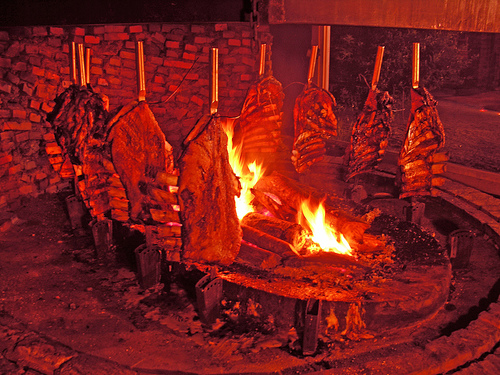
Photo: Eduardo Amorim
I’ve invited Dr. Michael Eades and Dr. Mary Dan Eades, two of my favorite bariatric (obesity treatment) doctors in the US and the first to introduce insulin resistance to the mainstream, to explain the facts and benefits of increased saturated fat intake…
The sub-headings are mine, and a few edits have been made for space and context. Please see Dr. Michael Eades’ references and responses to questions in the comments.
Mid-Section Fat Loss: Problem Solved?
A couple of generations ago two physicians—one on the East Coast, one on the West—while working long hours with many patients, serendipitously stumbled onto a method to rapidly decrease fat around the mid-section. We’re sure that other doctors figured out the same thing, but these two were locally famous and published their methods. Interestingly, neither was looking to help patients lose weight.
Blake Donaldson, M.D., who practiced in Manhattan, was looking for a treatment for allergies; Walter Voegtlin, M.D., a Seattle gastroenterologist, was trying to figure out a better method for treating his patients with Crohn’s disease and ulcerative colitis. Dr. Donaldson got his inspiration from a meeting he had with the aforementioned Vilhalmur Stefansson; Dr. Voegtlin came up with the same idea based on his knowledge of comparative anatomy. Though they came at two different questions from very different angles, they arrived at the same dietary answer. Both solved the problems they were seeking to solve and, coincidentally, noticed that their overweight patients lost a tremendous amount of fat from their abdominal areas while undergoing the treatment. As happened later with us and with Dr. Atkins, word of their success in combating obesity spread rapidly, and before long both physicians were deluged with overweight patients seeking treatment, completely changing the character of their medical practices. In retirement, both wrote books about their methods. Donaldson’s was published in 1961; Voegtlin’s in 1972. And as far as we can tell, although their years of practice overlapped, they never knew one another.
What was their secret? What did these two men independently discover? What kind of nutritional regimen did they use to bring about such great results in their patients?
Both had their patients follow an all-meat diet.
An all-meat diet?
Yes, an all-meat diet. Remember that when these physicians were in practice, there hadn’t been all the negative publicity about saturated fat and red meat that there has been in recent years. At that time, most people considered meat as simply another food, just like potatoes, bread, or anything else. No one worried about eating it. The (misguided) hypothesis that fat in the diet causes heart disease hadn’t reared its ugly head, so telling people at that time to go on an all-meat diet didn’t provoke the same sort of knee-jerk emotions that it does—at least in some quarters—now.
The patients who followed these all-meat diets rapidly lost weight from their midsections and improved their blood sugar and blood pressure problems if they had them. Calculations of cholesterol in all its various permutations was still decades away, but both doctors even used the all-meat diet for their patients with heart disease without problem. The all-meat diet proved to be a safe, filling, rapid way to help patients lose abdominal fat while improving their health. And remember, one of these diets was developed to treat GI problems, the other to treat allergies. The rapid weight loss that followed was a surprising, but welcome side effect.
7 Reasons to Eat More Saturated Fat
In the not-so-distant past, the medical establishment considered all fats equally loathsome: all fats were created equal and they’re all bad for you. Things have changed in that quarter, if only slightly. You have no doubt heard the drumbeat of current medical thinking on fats: some fats are now good for you—olive oil and canola oil*—but others are bad for you—trans fats and all saturated fats. That’s an improvement from the old cry, but far from the truth.
It seems that no matter how the story spins from the denizens of the anti-fat camp, one piece of their advice remains staunchly constant: “You should sharply limit your intake of saturated fats.” The next admonition will invariably be, “which have been proven to raise cholesterol and cause heart disease.” Their over-arching belief is that saturated fat is bad, bad, bad.
You see with just a glance at [our suggested meal plans] that we’ve included fatty cuts of meat, chicken with the skin, bacon, eggs, butter, coconut oil, organic lard, and heavy cream in the plan. Aren’t we worried that these foods will increase your risk of heart disease and raise your cholesterol? In a word, nope. In fact, we encourage you to make these important fats a regular part of your healthy diet. Why? Because humans need them and here are just a few reasons why.
1) Improved cardiovascular risk factors
Though you may not have heard of it on the front pages of your local newspaper, online news source, or local television or radio news program, saturated fat plays a couple of key roles in cardiovascular health. The addition of saturated fat to the diet reduces the levels of a substance called lipoprotein (a)—pronounced “lipoprotein little a” and abbreviated Lp(a)—that correlates strongly with risk for heart disease. Currently there are no medications to lower this substance and the only dietary means of lowering Lp(a) is eating saturated fat. Bet you didn’t hear that on the nightly news. Moreover, eating saturated (and other) fats also raises the level of HDL, the so-called good cholesterol. Lastly, research has shown that when women diet, those eating the greatest percentage of the total fat in their diets as saturated fat lose the most weight.
2) Stronger bones
In middle age, as bone mass begins to decline, an important goal (particularly for women) is to build strong bones. You can’t turn on the television without being told you need calcium for your bones, but do you recall ever hearing that saturated fat is required for calcium to be effectively incorporated into bone? According to one of the foremost research experts in dietary fats and human health, Mary Enig, Ph.D., there’s a case to be made for having as much as 50 percent of the fats in your diet as saturated fats for this reason. That’s a far cry from the 7 to 10 percent suggested by mainstream institutions. If her reasoning is sound—and we believe it is— is it any wonder that the vast majority of women told to avoid saturated fat and to selectively use vegetable oils instead would begin to lose bone mass, develop osteoporosis, and get put on expensive prescription medications plus calcium to try to recover the loss in middle age?
3) Improved liver health
Adding saturated fat to the diet has been shown in medical research to encourage the liver cells to dump their fat content. Clearing fat from the liver is the critical first step to calling a halt to middle-body fat storage. Additionally, saturated fat has been shown to protect the liver from the toxic insults of alcohol and medications, including acetaminophen and other drugs commonly used for pain and arthritis, such as nonsteroidal anti-inflammatory drugs or NSAIDs, and even to reverse the damage once it has occurred. Since the liver is the lynchpin of a healthy metabolism, anything that is good for the liver is good for getting rid of fat in the middle. Polyunsaturated vegetable fats do not offer this protection.
4) Healthy lungs
For proper function, the airspaces of the lungs have to be coated with a thin layer of what’s called lung surfactant. The fat content of lung surfactant is 100 percent saturated fatty acids. Replacement of these critical fats by other types of fat makes faulty surfactant and potentially causes breathing difficulties. Absence of the correct amount and composition of this material leads to collapse of the airspaces and respiratory distress. It’s what’s missing in the lungs of premature infants who develop the breathing disorder called infant respiratory distress syndrome. Some researchers feel that the wholesale substitution of partially hydrogenated (trans) fats for naturally saturated fats in commercially prepared foods may be playing a role in the rise of asthma among children. Fortunately, the heyday of trans fats is ending and their use is on the decline. Unfortunately, however, the unreasoning fear of saturated fat leads many people to replace trans fats with an overabundance of polyunsaturated vegetable oils, which may prove just as unhealthful.
5) Healthy brain
You will likely be astounded to learn that your brain is mainly made of fat and cholesterol. Though many people are now familiar with the importance of the highly unsaturated essential fatty acids found in cold-water fish (EPA and DHA) for normal brain and nerve function, the lion’s share of the fatty acids in the brain are actually saturated. A diet that skimps on healthy saturated fats robs your brain of the raw materials it needs to function optimally.
6) Proper nerve signaling
Certain saturated fats, particularly those found in butter, lard, coconut oil, and palm oil, function directly as signaling messengers that influence the metabolism, including such critical jobs as the appropriate release of insulin. And just any old fat won’t do. Without the correct signals to tell the organs and glands what to do, the job doesn’t get done or gets done improperly.
7) Strong immune system
Saturated fats found in butter and coconut oil (myristic acid and lauric acid) play key roles in immune health. Loss of sufficient saturated fatty acids in the white blood cells hampers their ability to recognize and destroy foreign invaders, such as viruses, bacteria, and fungi. Human breast milk is quite rich in myristic and lauric acid, which have potent germ-killing ability. But the importance of the fats lives on beyond infancy; we need dietary replenishment of them throughout adulthood, middle age, and into seniority to keep the immune system vigilant against the development of cancerous cells as well as infectious invaders.
—
Footnotes:
*We advocate the use of olive oil, but recommend against the use of canola oil, despite its widely perceived healthful reputation. In order to be fit for human consumption, rapeseed oil (which is canola oil) requires significant processing to remove its objectionable taste and smell. Processing damages the oil, creating trans fats. Also, the oil is sensitive to heat, so if used at all, it should never be used to fry foods.
###
The above post is an exclusive excerpt from Dr. Eades’ newest book, which is directed at people who want to reduce abdominal fat. Despite the title, the principles it details are ideal for anyone who wants to decrease both visceral (internal) and subcutaneous (under the skin) fat in the abdomen.
Comment Rules: Remember what Fonzie was like? Cool. That's how we're gonna be — cool. Critical is fine, but if you're rude, we'll delete your stuff. Please do not put your URL in the comment text and please use your PERSONAL name or initials and not your business name, as the latter comes off like spam. Have fun and thanks for adding to the conversation! (Thanks to Brian Oberkirch for the inspiration.)
Tim, I just finished reading your book and love your work – you have done your research! A client of mine contacted me regarding strength training and nutrition coaching amongst some others, and was attracted to my site after having read your book as the concepts I already use are parallel to many of yours.. although perhaps not so obsessive! What am I kidding, we all have our own version of OCD don't we 😉 Keep writing, I will too 😉
this is way off! Saturated fats are not good at all. You want the Mono and poly unsaturated. This is a ridiculous post!
I agree with what you are saying, but the high saturated fat diets based on available foods today are not the same as the foods we ate in ancient times. I define that as prior to 11,000 years ago when we started to farm and eat lots of grains. Grass fed animals are higher in omega 3 than commercially raised animals that are feed grain to fatten and marble the meat before the animal is butchered. Even ocean raised farmed salmon is high in omega 6 (corn feed) when native wild fish are high in omega 3. Fat in a mammal is also different based on what part of the animal the fat comes from. For example belly fat is a different from of fat then other parts of the body, especially if the mammal has been feed grains. As for vegetarians, plants contain no B 12. After five years of a vegan diet the body will be striped of B12 and the person will get pernicious anemia…. in other words we stop making blood cells. Without B 12 we die. A vegetarian friend of mine told me that we no longer need animal products because we have evolved. Well, last time I checked we have not evolved to the point where we don’t need blood. Primitive man ate a tremendous amount of leaves and meat. The body chemistry with this type of diet changes to promote health and there are 8 times more nutrients in this type of diet compared to the average American diet. To learn more, read the Paleo Diet. P. S. Cell membranes are mostly cholesterol, as are hormones. Studies have shown that people that eat synthetic butter and synthetic lard (margarine and shortening) have flabby cell walls, and also higher cancer rates.
Coconut oil is one of the good LDL cholesterols and the molecule is too big to collect on artery walls, but it forms excellent cell membranes and has many other positive health benefits. Read the book, Eat Fat Lose Fat by Mary Enig. There is a great section in the book for health recovery and there is a section that goes into detail about how we have all been duped by the grain and edible oil industry. Did you know that they were able to manipulate their lobbyist to be placed as head of the FDA? It’s how we ended up with doctors and even the American Heart Association touting the benefits of trans fats and it was how the food pyramid was initiated and pushed in schools. I hate conspiracy stories, but I have finally come about and realized that money buys campaign advertising which places before us only candidates chosen by big business and the media is feed by studies paid for by big business. For example, there was a full half page article in my paper with the headline that calcium supplements did not decrease bone fractures. Basically it said that if you are 8 or 80 and you fall and rap your arm on the edge of a curb, the bone will break. In the last sentence it said that there was one exception and that was that there was a 50% reduction in hip fractures in the elderly. This was the only sentence that mattered since 50% of people in convalescent hospitals are there from a broken hip and half of those will die of complications and the other 50% will never get out and will die within three years. So if every person took calcium and vitamin D supplements, we would have 25% fewer people in convalescent homes. Since for the most part the only fractures that people die from are hip fractures the headlines should have read, 50% reduction in fatal fractures. Who would benefit from such misinformation?
Actually, the whole idea that saturated fats are bad is pretty recent in the grand scheme of things. The documentary "Fat Heads" (it's on Hulu and Netflix) is pretty enlightening. The filmmarker eats nothing but fast food for a month. He loses 12 pounds and feels great in the process. (Now, everyone knows that too much fast food is bad. But, he takes in a lot of saturated fats.) He does a lot of research into saturated fats, cholesterol, and carbohydrates. Carbs are the real thing to keep in moderation, as the body processes it as sugar, which it then stores in fat and tends not to burn as often or as easily as other fats. Grains (where we get the brunt of our carbs, vegetables are still good for you) are part of our diets now because of the development of agriculture, but these weren't really consumed in mass quantities in hunter gatherer times. The grains used in making high carb foods are an agricultural product — a great source of revenue for the farming industry, so of course we have been told that they are very healthy for us. Of course, now people are catching on, but we are still being told to avoid saturated fats because they "clog arteries," which actually isn't true. Clog arteries are a symptom of another problem — the documentary makes it clear. Eh, but in today's world, it's really hard to avoid carbs and processed food. Everything is so full of chemicals — meat included. Organic seems to be the best way to go, but it is often more expensive. Processed foods are fast and cheap. Also, carbs are delicious. It's a dilemma.
Glad to see other people worrying about their health and adopting the Paleolithic Diet, I live on a diet of meats, organs, organic butter , coconut, leafy greens and vegetables and i feel better than ever, i'm at a low bodyfat whitouth much exercise, my inmune system works like a train, have good appettite etc etc, i just feel better overall, even my reflexes are sharper, the best source of fats nowadays is organic butter and coconut milk, followed by red muscular meat of grass fed beef, the most optimal would be to get them from the meat and organs of wild game, but it is very expensive and not everyone can afford them, so i recommed the above and also a good daily omega 3 source like cod liver oil.
Saturated fats are good and healthy, saturated fats are good and healthy, saturated fats are good and healthy healthy be saturated fats.
Diet discussions are really interesting exercises in partial facts. I am 67 years old in perfect health and try to eat reasonably. That is: Lots of Much less vegetables wheat products fruits animal products nuts raw juices & vegetables fish / omega 3 fats & oils spices yogurt, etc. Including an occasional nice steak and as close to ZERO as possible of Salt, Sugar, Trans Fats, Fast Food, chips etc. And lots of water and physical movement – weights, cycling, walking and floor exercises. Understanding that this is probably not an ideal extreme diet, but compared to friends who are always searching for some magic diet – I seem to be in much better condition and health. Generally I have not eliminated any reasonably grown or prepared food – just tried to neither exaggerate on the carbs or eliminate properly raised and fed animal based products. Any consideration of diet cannot include much sitting on your duff, watching brain numbing tv. For a healthy body, it is "use it or lose it" Regards
The 8th reason to eat foods with saturated fat is that they taste good. Chicken is so much better with the skin, non-fat milk is bland and watery, and I cannot even imagine eating eggs without the yolks. If these foods tasted better without fat, then our ancestors would have eaten them that way, but the truth is that our taste buds guide us to the most nutricious foods.
Since my first post, after some aggressive clearing work re food compulsions I think my body and my mind is now ready to take it to the next level of Dr. Cassar's Food Pyramid, here: http://www.youtube.com/watch?v=LgaB9sxNq0w Dr. Mercola now offers for free his Nutritional Typing chart and since I am a protein type and I want to raise my body vibrationally I am going to test out blue green algae (high protein content) with virgin coconut oil (fats/oils) and see if I can wean the body off of red meats marbled with fat. I am NOT a vegan nutritional type and do not know how this will go down….wish me the best 🙂
This is unbelievable. So many ignorant comments in here. I'm actually a huge follower of Tim Ferris, but this article is getting misinterpreted. While yes, you should eat some saturated fats for the reasons Ferris listed above, eating them in excess is ridiculous and if you read his book "The 4-hour body" he does not recommend a high-fat diet, or an exclusive protein diet, or anything remotely close to those! Most recently this comment from Ronny, our body does not recognize healthy foods because they taste good!! I will not indulge into a discussion about taste buds, but fats and sugars are not the best components of our diets even though most Americans regard them as healthy… Even Ferris agrees that you should avoid fast carbs such as sugars and eat slow carbs such as whole grains and fiber. I have followed a lot of the nutrition Ferris recommends, and have gotten to 4% body fat and feel the best I've ever felt. Conclusion, don't eat a ton of fats. Period. Now don't take that statement ignorantly to imply avoid them, just simply focus on what your body does need, and you won't eat excess fats. Focus on eating protein and slow carbs (I recommend beans) in the morning within an hour of waking up to boost your metabolism and keep you feeling full for a good bit of the day. Just read his book and not one unique article about a few researchers that gained results from excess fat, and then ignore the thousands of research articles that promote avoiding excess fats, sugars and other unhealthy chemicals (i.e. caffeine).
Adding saturated fat only to the diet want be good enough. To get really good benefits from SFA we must switch to diet completely based on SFA’s. I’m not saying, eat only fat, no carbs and no proteins. However, perfect amount of fat in diet should be around 60-80%. That’s what Vilhjalmur Stefansson observed among native Eskimo, and he switched to this diet also (you can read about this diet in “Not by bread alone” by Vilhjalmur Stefansson). Now, what is important? To make sure that at least 50% of consumed meat and fat is in raw state. It may sounds a bit nasty but it’s easy to achieve (and tasty!). Another important factor is physical activity. The person who wants to get most of benefits from “Eskimo diet” should move everyday. That’s the way we are made, we move to eat, then sleep and again move to get some food and survive. Eating without moving is a recipe for illness. One more important factor, try to not overheat your fats. Use mainly animal saturated fats (they are chemically stable, unlike vegetable oils) and eventually a bit of coconut oil. Go for lard, suet and ghee. If you want to know more about Eskimo type diet you can type in Google “optimal diet Kwasniewski”. He is a Polish doctor who 30 years ago designed high fat diet, which is still very popular in Poland (polish former president Lech Walesa repaired his health and lost pounds while on this diet). Of course “Optimal diet” and other fat diets should be used under supervision of doctor. We have to remember that our bodies aren’t healthy (modern human is a very weak and sick specie). High fat diets are generally healthy but for older people may be dangerous. Anyway, SFAs are good for you so if you can try to switch to high fat diet. Thanks
Splendid article. Nothing at all wrong with consuming animal fat. I came from a very impoverished background and, as a child, many of my meals consisted of beef dripping sandwiches. I never knew any really fat folks, then, and that was many, many years ago. I am now in my seventy-eighth year and fit as a fiddle, I still eat plenty of fat (but no vegetable oils except coconut) I consume about two pounds of butter a week, and just love lamb fat! I know lots of people who are paranoid about eating anything containing fat, and most of them have a serious weight problem. This low-fat myth is one of the biggest frauds ever perpetrated on the public.
Fantastic article. There are pros and cons to everything and saturated fats pros have been overlooked.
I completely agree with these viewpoints. I have personally lived on the low-fat high carb diet for almost 30 years and yet kept gaining weight and had a completely screwed up lipid profile. The Dr. almost put me on statins and thats when I decided to take matters in my own hands and started investigating exercise and good fats for heart health. I was of course shocked to not find a single piece of evidence that correlated dietary cholesterol to lipid cholesterol. I then started investigating saturated fats and still couldn't find any evidence that saturated fat will cause heart attacks. I think when it comes to heart disease most of the medical community works off of hearsay where a doctor goes up on stage and announces, as-a-matter-of-factly, that cholesterol and saturated fats cause heart attacks and then the other doctors cite the previous doctor in their publications and so on and so forth. Its a vicious circle that's been perpetuated for the last half a century and its time the medical community come clean. I highly doubt that's ever going to happen given the fact that demonizing cholesterol has created a $26 billion industry of statin drugs that sponsors more research in this area. If you are a medical researcher serious about your career you better not say anything that will go against conventional wisdom of "cholesterol is evil" otherwise your grants will be cut and you will never publish any thing ever again. So from that standpoint I think the situation is abysmally bleak, but thanks to people like you there is some hope for people that are willing to take health matters in their own hands. Thanks for taking the initiative to educate the ordinary people about whats healthy and whats not! Regards, Yogesh Verma
Hi Tim, I really enjoyed your post on saturated fat. I'd like to link to it on my blog, if that's okay. And I got a lot out of your video on blogging. A few of the things were beyond my level of expertise, but I made some notes, and I'll look them up. Thanks, Myra
For years I have said you must eat to lose weight & removing saturated fat is wrong, When you remove saturated fat from your diet, you usually replace it with simple carbs,,,,,sugar. saturated fat, mainly dairy, is the best fat you can eat, for many reasons. just like everything else, not too much. People laughed at me when I said "eat to lose weight" they are not laughing now, mainly the people who went on these diets and got ill or fatter & weak and had no energy to exersize. I got laughed when I said and still say "eat fat to lose fat" now the experts are saying that too. increase your heart rate to 65-75% of your max rate for 20 minutes every day & you will benifit from the saturated fat you ate. you will also have the energy to do the exersize every day and you will probably increase that to 30 minutes or twice a day. It does not take much effort to get to 70% of your max rate,
I can see your argument, and it's a valid one too. I continue to eat meat because.. ok, yeah, it tastes good. 🙂 but I also think the body needs it. An all meat diet??? I don't think I could hang. I think everyone is different, and some bodies do better with more saturated fat in their diet than others.
First it was the 4 hour work week, now its the 4 hour body. It was great seeing you at the launch party in NYC Tim!. I'm a big Fan of Volek, Eades, Taubes, Sission, etc. I've read a lot of the medical literature and scientific journals, but the comments and responses to this blog post are simply amazing! I've received so much information from Eades' responses alone!
I have recently started a low carb diet and am taking in more saturated fat. I found more information on this page: http://www.kriskris.com/10-reasons-to-eat-saturated-fat/
I think coconut oil should really be emphasized here. The best saturated fat out there. There are whole books written on its benefits and how it speeds up the metabolism. You mentioned it, but I would like to emphasize it even more.
Well, I would like to add something following my last post (Sept. 1st. 2011). I am now in my 79th year and have recently had a medical check-up. My cholesterol is normal, as is my blood pressure. Interestingly, I have researched my family history as far back as 1635, and longevity seems to have been the norm. My g.g.g.g grandfather, who was a butcher, and so probably consumed lots of meat, died in 1842 at the ripe old age of 84. Seems like saturated fat didn't do him much harm. Two of his sons, my ggg.grandfather and g.g.g. granduncle, also lived to be 79 and 84 respectively despite the fact that they were also butchers. Compare the list of ingredients on a pat of real butter, milk and salt, to what is in a pack of this low-fat rubbish. More additives than you can throw a stick at. And the manufacturers have the gall to tell people that it is good for them. I am frankly amazed that apparently intelligent folk can be taken in by this quackery. Finally, as has been stated here in previous posts. a healthy daily dose of vitamin D is one of the finest aids to good health that there is. I take 10,000 IUs daily and never have a cold or flu. Cheap at only £27 a year. Also, I don't have useless flu jabs.
Fantastic article and so pleased to have this information to back up what I teach all my clients, that fat is does not make you fat! Unfortunately not all take on board what I say, but myself, I eat loads of eggs, cheese, full fat milk, lot of nuts, seeds and oils and have a good range of quality fats in my diet, love red meat and fish. Since I have eaten like this for 2 years, I feel great, my bodyfat is 9-11%(I also train a lot) and at 41 I have the metabolic rate of someone in their teenage years. My body and mind are in balance, my bones and teeth are healthy, and my nervous system works. I have had no colds/illnesses for 2 years and my immune system is bulletproof. In fact I know that the saturated fats in my diet keep my immune system functioning whilst training hard for triathlon. I will spread the word by letting all I know read this article. Keep up the great work. Many thanks Steve
Wow, I bet a lot of nutritionists are shaking their heads or swallowing their pride. It's a pretty big shocker. But does that mean that the average 2000 calorie consumer can eat a half stick of butter, provided that the calories are accounted for. In other words, what is the amount you'd recommend in the average 2000 diet. Also, are you saying were better off with 20g (the maximum recommended DRV) than 0g or 65g (The maximum DRV for total fat) than 0g? I have to say, I'm a little intimidated by butter, whole milk, and fatty ground beef, but I consume unsweetened chocolate and coconut oil sans worry
I just had an AH! moment watching a video on this blog sight. http://www.fourhourworkweek.com/blog/2009/06/06/saturated-fat/ I had actually never heart this and i have done lots of research on the web. Where does saturated fat come from? Animals, What are we-Animals- so we store fat as saturated fat. Why would our body store something that is supposed to kills us on our body to use as fuel.
Saturated fats and Unsaturated fats are one of those things I often get confused. Many times I find myself standing in the middle of the grocery isle staring at the nutrition label pondering, am I supposed to get more…or less of this one. Usually you can’t go wrong with Olive oil and nuts, and by staying away from processed food. The final tip on Rapeseed oil, and Canola oil was very helpful. While I recognize it, I often forget the significance of Rapeseed oil in the ingredients list. Thanks alot for this one.
Why olive oil and not coconut oil?
2/3/13 Two and a half years ago, the doctor wanted me to be on meds to prevent heart attack and stroke. My blood test results were a mess, my cholesterol and triglycerides were high, hdl and ldl not good, and blood sugar was high. She didn't mention the words insulin resistance (not much of a teacher to her patients). I felt terrible. Reluctantly (she didn't explain the reason for this med) I went on an ACE inhibitor, developed complications and she tried to put me on another even more dangerous, so I stopped seeing her and began reading. One of the books I read (among many) was PROTEIN POWER LIFEPLAN. Felt better almost immediately and 27 months later 50 pounds of fat are gone and I feel like "a million bucks" at age 68. I also read Dr. Bernstein's books, from which I understood that I should never go back to my former diet, which was not filled with fast food and sugary desserts but was quasi vegetarian and very low fat. On that I'm certain that I would have died, which was my former doctor's probably reasonable and fair diagnosis, but she insisted that low-carb diets didn't work and were dangerous. She also believed vegetables and fruits are not carbs — her exact words, not mine. From excellent articles in Well Being Journal, I've learned that I can have about 8 tablespoons of saturated fat per day, and also have learned that it suits my metabolism perfectly — and my blood tests confirm that it works for me. I don't know if "once a diabetic, always a diabetic" is true but for me or if I simply have the true Paleo metabolism, but if I overeat carbs, which I do only once in a while, even if only a cup of green beans versus 1/2 cup, I feel terrible. It's very uncomfortable for me to digest "too many" carbs. I have typical symptoms of indigestion, which are very uncomfortable. My body craves butter, cream, and fatty meat just as Dr. Donaldson prescribed for his patients, and only on that regimen do I feel better than I ever have even as a child. Sticking to PROTEIN POWER LIFEPLAN's stricter phase is working for me, and I know from experience that I need to keep my carb grams per meal very low, so I'm doing what works for me, to keep me feeling good and maintianing my health. Anyone who is carrying a lot of body fat in the midsection as I was (I'm still losing but very slowly, so I had more than 50 pounds of excess b.f.) should read Eades, Bernstein, and Donaldson and get on the high-fat low-carb plan, on which they never have to skimp on food that will support not only weight loss but improved health while enjoying all the steaks/chops/poultry/fish/game that they like, and losing body fat, not muscle as happens low-fat high carb (heavy on veggies, fruits, and starches) diets. Low carb may not be for everyone (those who do not fatten on high-carb diets), but the evidence of my eyes walking everyday among the fattest people on earth suggests that most in the USA need to be on high-fat-low-carb, and quickly. The caveat, this will be the dietary plan for the rest of their lives if they want to maintain their health.
LOSE BELLY FAT? I DECLARE BS! Almost every weight loss article published refers to belly fat. Some guru giving exercise's that will reduce your belly. People are very conscious and concerned about belly fat. Perhaps so many insist on making false claims of spot reduction because they are attention grabbers. That's a poor reason to give misleading or false information. The body just doesn't work that way. When we burn fat it is metabolized from all of our stores. Not one particular spot. If spot reduction were possible a tennis players racket arm would logically have a lower percentage of fat. Yet when tested the fat percentage is the same. There is no miracle pill, food or exercise that will cause spot reduction. Where we store our fat is predetermined by body-type and genetics. Therefore as we lose fat the more heavily deposited areas will be the last to go. Consistent exercise, a healthy diet, time and patience are the way to a lean healthy body. Spot reduction, forget about it. It's just not going to happen! A strong core will help you to hold your stomach in making it appear less fat. So will a girdle. Proper diet, exercise, and time will reduce it….God bless
Very nice article Learnt a lot Thanku
Hm…now I'm totally confused, I can see their point, but I also know that meat is acidic, and acidic environment is heaven for sickness. Is there any ways to get saturated fats from something that;'s not meat? I lost 28 pounds by eating eating well (eliminated sugar, diary , gluten and wheat, I got tested and was found to be allergic to them). I have about 10 more pounds to go for my perfect" body, and most of my stubborn fat is around my waist, I tried eating all meat for one day once, next day when I woke up I was noxious and felt awful, so I know this all meat style of diet will not work for me. Is there another miracle cure for belly fat?
I can attest for this being true, as an Argentinian that loves asado! 🙂
Well I appreciate your article. I am a high fat raw vegan. I eat principally fruits and a lot of veggies with PLENTY olive oil or walnuts oil everyday. My salad are always full of avocados and and as I say I dump a lot of olive oil. I consider high quality saturated fats as "healthy" like the ones on coconut oil , olive oil or walnut oil. However I do not eat animal fats and I do not consider them healthy unless you eat your meat & fish raw , but if you cook it , the level of toxicity raises. But that's my opinion. By consuming a large amount of oil everyday people often are worried about the 20% saturated fats remaining in them, well I explain them what you just posted in your article. Good job! Thanks.
It's interesting how wrong conventional wisdom can be. I enjoy using coconut oil. I don't know if its directly related but I've found my complexion improves with its use. And other than vegetarians, who wouldn't love an excuse to eat bacon?
The reason for saturated fat being good for bones is likely due to it's association with vitamin K2, which is only found in animal fats, especially grass-fed sources of butter. Vitamin K2 is essential for bone formation. Just saying.
Thank you for this posting! I have become allergic to EVERYTHING this past year and its because of leaky gut syndrome. I have started a low-residue diet and incorporated coconut oil as my main source of calories. I am satiated with 3 tbsp of coconut oil a day (two in water or tea and one taken as a spoonful). I do not know that I will lose weight but that is not my goal anyway. When I tell people I eat coconut oil the freak out!! Thats FAT!!, I remind them that I know this with a smile. I want to stop having food reactions and GI discomfort. Wish me luck, I have a game plan and hope to see some improvement soon.
Hooray!!! Someone talking sense at last!!! the Masai have been living on a diet of full fat milk and meat and they have one of the lowest heart disease rates in the world – but guess what? they dont have a Cirspy Creme nearby and aren't filling their bodies with white starchy carbs. I'd love some advice though – my 8 year old son has type 1 diabetes, I'd love him to be less dependant on insulin, but the docs keep telling us he has to have starchy carbs as part of his diet. What would you recommend? thanks!
Hi – I find that Coconut Oil offers many benefits… helping metabolism, skin, hair, etc. I'm not sure what to think about the Alzheimer's stories, though. Have you heard of CO having a real impact on that disease, as discussed in the below post? Thank you. Alzheimer's Disease – Dr. Mary Newport, after failing to get treatment for her husband's dementia, discovered that coconut oil contained natural medium-chain triglyceride (MCT). The same substance was used in a drug trial her husband failed to qualify for. So, she gave her husband 1 tbsp. of coconut oil twice a day for a month and a half and saw him almost completely recovered. (http://www.naturalnews.com)
References?
I like MODERATION…in all things. Never overdoing it on any food. Moderate intake of calories to maintain a healthy/comfortable weight. Limiting processed foods and exercising in a moderate fashion, as well.
It's an remarkable piece of writing in support of all the online people; they wil obtain advantage from it I am sure.
Some of this does sound somewhat beneficial but increasing the amount of saturated fats also increases the bad cholesterol in blood cells. Humans already produce enough cholesterol for their body on their own; so there's no need to increase the amount of saturated fat intake. Especially since it increases the amount of bad cholesterol. This can lead to way to much cholesterol in the blood stream thus causing heart problems. In conclusion, everything has its benefits but in this case the bad outweighs the good. This is why you don't see articles from sources like .edu or .gov saying to increase the amount of saturated fat intake. Really you should be eating a maximum of 10% or lower saturated fatty acids otherwise you may OD on cholesterol intake.
Make sure to eat foods that are rich in fibers that can help fight off toxins thus improve and enhance your overall health.
It has been commonly believed that consumption of foods containing high amounts of saturated fatty acids (including meat fats, milk fat, butter, lard, coconut oil, palm oil, and palm kernel oil) is potentially less healthy than consuming fats with a lower proportion of saturated fatty acids. Sources of lower saturated fat but higher proportions of unsaturated fatty acids include olive oil, peanut oil, canola oil, avocados, safflower, corn, sunflower, soy, and cottonseed oils.
By fat the dumbest article iv ever read, not citing hundreds of scientific articles and journals supporting the fact that an all meat diet kills and is the probable cause of the number 1 killer heart disease in this world. Eskimoes are a population who lived soley off a meat based diet, highest rates of osteoporosis in the world, protein acidfies the body pulling calcium from the bones, meats are not what they use to be in the wild? Meats are high processed and more then 10 compounds in meat (carnitine, nitrogen, saturated fat, hormones etc) have been found to be carcinogenic in both mice and humans, I cant believe this claim you use that lions brains and our brains are made of fat so eat more fat, thats not how it workds buddy, yes fats are an essential healthy part of the diet but from clean animal sources and plant based fats like avocados, nuts, seeds. a nice crack cocain diet can help us lose weigh, anorexia can help us lose weight, fasting can help us lose weight, that doesnt mean its good for our body or optimal health? people before you listen to this blogger who has no idea what he is talking about do your own research period.
Thanks for sharing Tim! I recently read an article that saturated fat isn’t the heart-clogging poison the media would have us believe.
I like your ideas about reducing costs in the health care system is too good
The problem is that for the most of the population are not grass-fed organic beef, naturally raised lamb, organic raw dairy products and coconut oil their main sources of saturated fats. Today, are people in the rich countries overeating on corn raised animal products, chips, and cookies with saturated or trans fats, and all of this should be limited as much as possible.
I Try to have natural juice drinks at least 3-4 times per week, as well as take omega 3 fish oil 2-3 times per day with meals. Before I satrted doing this I felt VERY sluggish throughout the day. When you start getting older its important to take a proactive role in your daily health. On a side note, until I read this article I never even heard of " lung surfactant". Wow that's pretty scary that even a non-smoker has to worry about lung health just from what they eat.
How about the fat content of grass fed vs grain/corn feed beef and omega 6 : omega 3 ratio differences between the two? How important is this ratio to cardiovascular in particular and health in general?
Hi Tim, Thanks for the great article. Can you follow up wit either links or the books that contain their "suggested meal plans" from paragraph 11. I generally track a 50% protein, 30% carb and 20% fat diet of 1200 calories for weight loss and would be interested to see how this would change by following their recommendations.
This diet seems very similar to The Atkins Diet. High protein, no carbs. Medical opinion is divided on the safety of this diet, but no question that it works. You feel full, since you can eat all you want of the approved foods. But with no carbs (which is processed by your body as sugar, just like eating candy) your body goes into ketosis and believes it is starving, so it starts using stored fat to convert to glucose. And the weight comes off fast. I lost 70 pounds in a year and was never hungry. Steak, bacon, shrimp, salmon, butter, real cream, nuts, berries, all permitted. Just no sauces which generally were made with ingredients containing sugar. And ZERO carbs. No pasta, potatoes, corn, bread, rice, legumes, beans, etc.
Some of his recipes in the book allow Stevia, Fruit, heavy cream and other ingredients that SCD doesn't recommend. Do we just leave those out?
Are you familiar with Weston Price's work? You should read his book 'Nutrition and Physical Degeneration'. It's so great you're talking about the fat myth. People get it so wrong about nutrition when they follow their docs instructions. Thank you!
This is not current with scientific research. Sat fat from animals is paired with Trans fat … very bad news for brain etc.
Humans have been eating saturated fat for 2.6 million years. Ever since 1977 the government has told us otherwise. I'll follow the steps of our ancestors rather than some government committee.
Excellent article! In 2 months I will be running the Berlin marathon fully keto adapted (I ran Boston twice on Tim's slow carb regime). My experience with an 80+% fat nutrition is fab. I don't have any cravings and sleep well. The only, only downsides so far are dry eyes and challenges when eating out.
I happen to disagree completely with this article. If your brain is composed naturally of cholesterol and fat, and if your lung cells have a saturated fat component, it is because your own body is elaborating these on its own. You don't need to eat or supplement saturated fat to your body for any reason, unless you really want to suffer from coronary disease too soon in your life.
Most canola at least In Canada is roundup ready. Which means being sprayed with pesticides doesn't kill it, just makes it more flavourful.
This article is dangerously uninformed. Look at the China Study and the OMS study which has been running for 40 years (not a typo 40!). Sat fats DO NOT promote a healthy brain, they are directly linked to increased lesion count and risks of MS development. I am not sure which meat lobbying board is behind this but as others have noted, no citation and reads very advertising (little a!! Come on guys). Give me one University that put it's name to a published study referenced here and I will re-read this with less cynicism. Yes cavemen did have a meat dominated diet but also had rickets, dreadful teeth and a life expectancy of 25 years. Nope not for me. Mediterranean diet rules.
Interesting. There’s a lot of contradictory information about this subject. I was very underweight so I went onto a high calorie diet. When a substantial portion of my calorie intake was saturated fat, I began to get cramping in my chest, left shoulder/arm and angina type symptoms so I had to ditch all saturated fats from my diet. So, I am a bit confused as to what to make of this.
You completely missed one of the more important aspects of saturated fats and that is that it is the basis for hormone creation. You need cholesterol to create hormones.
Boom! I've been researching a lot of this lately and I'm glad to come across this article. It's nice to hear the perspective of someone who would have much less corporate profit interest solely for the sale of certain harmful foods and myths. I like your point about how you probably haven't seen this in your mainstream media… haha spot on! Saturated fats are important to get from a range of sources, along with more Omega 3s than 6s, like what comes in the forms of trans fatty vegetable oils and such. A hard lesson to learn but helpful! – Evan
What is your take on Liquid MCT oil as a saturated fat and overall? I like it best on a spoon first thing in the morning
There's also significant research that saturated fats prevents gallstones. The complete opposite of what I was told. [Moderator: link removed]
This article just plays into everyones bad habits. This way of eating will kill you. It is completely unsustainable, talk to any bodybuilder and they will tell you they get tired of eating high protein, and it makes them agro. But good luck with this thinking.
This is a very surprising article. I was diagnosed last January with fatty liver and the only fat that was in my diet that had saturated fat in it, was meat which I ate every day. I dropped the meat and grains and went vegetarian with no dietary or doctor advice. The reason was the vegetables and fruit was all I could eat without major pain. (The doctor told me to just reduce meat intake for a little while but it was nothing to worry about???) 12 months later I am 24kgs lighter and able to hiking for miles. I think one of the main problems with the chronic disease in the western diet is meat and the industrialised farming in horrific conditions. If you look back to my grandmother's day, they ate meat once a month if they were lucky and they all lived long happy lives
There are always different ways to reduce abdominal fat. One should look into certain things which can burn abdominal fat like avoiding junk food, irregular food habits, alcohol etc. You need to cut down on all these and take necessary precautions to reduce fat.
Can you reference this study with peer reviewed studies? Research is showing the complete opposite of what you are saying. Take this for example http://nutritionfacts.org/video/diabetes-as-a-disease-of-fat-toxicity/
Interesting footnote on rapeseed oil would like to know were the source study for that is. I was told it had a higher flash point so was better to fry with.
Been doing the Ketogenic diet for 4 months and not tolerating the super high fat too well (though I've lost 25 lb!) so switched to 4 solid days of slow carb diet (still with lots of fat) and 3 consecutive days of strict fasting…feel great and my ketones are 1-2 on fasting days…
Who to believe in this ocean of contradicting infos !?? Recently one doctor discovered that saturated fat cause metabolic syndrome and diabetes , not carbs ! I'm just saying , you should eat whole food diet and include everything
Terrifying. If eating animal products and saturated fat was pivotal to great health then I am sure donkey's do fly. This article and basis for it are proof that a guy who writes about a 4 hour work week is now a nutritionist. Show me verifiable proof by a physician with a nutritional background how he has reversed cardiovascular disease, diabetes, COPD and obesity through a diet high in meat and dairy. Its non-existent. Put the same folks on a high plant based diet with little to no added fat (broccoli, peas, oranges, have fat we don't need to add empty fat calories through any sort of oils) and you are going to have people with unclogged coronaries, increased pulmonary function, non-inflamed joints, increased energy and stabilized blood sugar. Oh yeah, and the Earth itself won't continue to erode-implode taking all of us with it.
No link to studies… And dr Atkins died Young and FAT
Eating more fats has greatly improved my life! Since I started eating more fat, I have significantly increased my energy and significantly decreased my appetite. But try telling your family and friends… they all think I'm crazy and just trying to trick them into getting a heart attack.
I would love to see the data or EVIDENCE behind these claims. I've been trying to prove to people what you are claiming but they all want hard data to back it up. From one friend: "I happen to have blood results that refute this very assumption around Lipo A. So am I am outlier, a high responder? What about the study Don D'Agostino did that concluded that 1/3 of the population has hyper sensitivity to saturated fat? I'd love to review that study and its protocols. The human body is complicated and everyone reacts differently. I think there needs to be way more in the way of human clinical trials from reputable research institutions that prove these claims with statistically significant data. I'd love to see the studies that he is referencing currently even to make the Lipo A claim."
With recent news about Coconut Oil. Will you confirm or change your opinion about it?
How do these doctors substantiate their claims? Can they present independent peer reviewed studies as evidence? There is a lot of evidence to suggest that a plant based diet low in animal fats is the best diet for optimal health. But, there a lot of dietary studies that suggest a spectrum of things, so I am never fully convinced of anything. However, independent organisations like NutritionFacts.org who constantly analyse and present scientific studies on their website advocate for a plant based diet. They have also critically analysed why some studies conclude that saturated fat is not unhealthy: https://nutritionfacts.org/video/the-saturated-fat-studies-set-up-to-fail/ I am just curious because the article doesn't reference any conclusive studies, but is just limited to statements like "there is a case". Does the book perhaps rely on conclusive studies which have not be used here for reasons of brevity?
Last year I did 4 months of keto. Good healthy fats in every meal and fat bombs as a snack. I have been looking for the role of healthy fats in this diet and have been surprised that non fatty meats are recommended. In keto non fatty meats are NOT recommended. Chicken breast was out and so was tuna… grass fed meats was all I had, butter, ghee, duck fat, olive oil, bacon and unlimited avocados….. so, whats the deal with healthy fat in the 4 hr body? yes or no? limited or unlimited? I have scanned the book again and again for the dietary fat chapter which seems to be MIA….. Thanks for some clarity!!!
Saturated fats are good for you when you take this in limit. Should try consuming more of healthy fats that are good for your brain and heart.
What a great read! Thank you Tim for this great post
where are the citations?
i thought saturated fat was bad for you?? is it not and is actually good for you? im confused
CDS, I’m encouraged by your 7 reasons to eat more saturated fat. I’ve been reviewing articles regarding using ghee as a cooking oil as well as olive oil. I’m still confused on the best dietary plan?
Őszintén szólva belépve az oldalra, azt hittem, hogy gyorsan kijutok innen. Sok hasonló cikk már cserbenhagyott. Beszédstílusa azonban meggyőz engem, és elnézést kérek elhamarkodott ítélőképességéért… Újabb olvasói 🙂
Spouting someone's "research" is not always productive. Observing cultures that are healthy is more helpful. I think many who are so combative against Weston A Price misunderstand his findings. He observed cultures where people lived healthy lives to 130 years and beyond. Some healthy peoples ate vegetarian; other people groups (Inuit) in Alaska ate almost entirely blubber and meat. The common denominator that Dr. Price found was that the healthy cultures ate "natural" food, freshly prepared each day — not preserved, no bleached flours etc., no hydrogenated fats treated with chemicals, etc. The Philipine culture (before it was contaminated with the American SAD diet did not suffer from Alzheimers, diabetes and many other diseases of the Western world. Yet the mainstay of their diet has been the coconut…. which is a SATURATED fat! However, it is a very healthy saturated fat. Saturated fat is GOOD!!!!! The oils on our grocery shelves are mainly those which have been hydrogenated to give them a long shelf life. However, coconut oil will not spoil on the shelf. It is naturally solid at room temperature and very healthy. It's wonderful! Never stop searching for the truth. Never stop learning. "Scientists" will often tell you wrong information for greedy purposes. I must say, Dr. Ornish was not a bad person, but he didn't have the whole truth. We need more fat in our diets. A low-fat /no-fat diet is definitely a heart killer. I know from personal experience. Thank you.
Joseph…I hope you've gotten the message: Virgin Coconut Oil is a SATURATED FAT. It's a wonderfully healthy fat. We've been taught a lie for many years. Saturated fat is not unhealthy. Unadulterated saturated fats have positive health benefits. TRANS FATS, chemically and heat treated fats are deadly to our system. Saturated fats and trans fats are not the same. Canola oil, on the other hand, is made from rape seed and need to be treated to remove the stink and bad taste before marketing. It is NOT a good oil in spite of what we've been told. Please be open minded enough to learn the truth. Research it for yourself.
Yummy! Just moved to a small town in Connecticut and the best locally is 2lbs of certified organic ground Angus beef. Tastes great as a raw mixture of sea salt plus some herbs (parsley, for example) and has not made me sick at all. Sells at BJs for about $3.50 per pound.. BTW, also makes a great meatloaf 🙂 I add parsley flakes to the mixture. Tastes awesome without cooking though — like cheating and eating cookie dough before baking 🙂
not true at all. I have the blood work to prove it.
Trayjayjay, don't be intimidated by foods that you get along with. I consume butter, cream, I would wager that I do consume 1/2 stick of butter a day along with coconut oil, bacon fat and whatever fat I can inhale off a nice piece of steak. I am pre-diabetic and my numbers stay normal when I eat this way. If you can eat coconut oil then why can't you eat butter? THe people that consume the highest amounts of healthy fats, including saturated fats, absorb the most nutrients from their diets.
UR so absolutely right Ron.Our metabolisms are made by nature (or whatever one wants to call it) to run on animal birds and fish fat and meat. If we didn't have access to carbohydrate for energy, our bodies make it, along with ketones that are preferred for energy by our hearts and brains. An old tv commercial ended with this warning "you can't fool Mother Nature". And that too is absolutely right.
Oh, I love wellbeing journal. I am so glad to see someonelse reading it.
Absolutely true. The body does need meat. Compare cultures whose diet is exclusively meat, such as the Inuits, and see that the have no incidences of obesity, diabetes or heart disease. They are of a sturdy stature and quite slim, muscular and strong bones.
Coconut oil is the healthiest oil out there. It will truly improve your health.
I love coconut oil too. I use it daily and I would bet that it is the coconut oil that is improving your complexion as it has also helped mine. I have the worse complexion on the planet.
Steve Cooksey, better known as the Diabetes Warrior does a low carb / primal /ketogenic diet that he began adding a little resistant starch and he has had good results with it. I will post a link here.
Just found a Chris Kresser article that also listed Sauerkraut and Natto as good vegetarian sources of K2. I'm a fan of butter & eggs sources personally. http://chriskresser.com/vitamin-k2-the-missing-nutrient
Your body will make saturated fat if you eat enough carbohydrates but that comes with its own risks. The idea that our primary means of storing energy (saturated animal fat) is also heart poison defies logic. Saturated fat is a component of heart muscles. Eating any amount of carb or sugar over what you can immediately burn or store as glycogen is converted to saturated fat for storage. What is your mechanism in the direct digestion of fats vs conversion that is pathological?
I am 100% agreement with this comment. NFL players are turning vegan and reducing their chronic joint pain, numbness and tingling associated with chronic soft tissue injury. Not to mention reducing man's total corruption of the planet and all its inhabitants. Let them eat this way though. They are young. Cardiovascular disease and prostate cancer hit men in their 50's. It all catches up and seriously…. population control. Our obesity epidemic and the way the American diet it slowly ruining health in so many other countries these days (KFC, McDonalds) perhaps is Nature's way of leveling out the playing field. Those HUGE food conglomerates who have the FDA in their back pockets want us addicted, dependent and our offspring addicted and dependent
Dr. Neal Barnard. His videos are good. His advice is solid.
Those people are not eating fat, they are eating junk food thus their body is not storing fat, rather than digesting it.
Mary, I'm so glad to "meet" others who need copious fats everyday. I'm eating about one stick of butter per day, don't really care for coconut oil but in the past made do with tablespoons of high quality olive oil every hour or so when I began high-fat/low-carb. Are there more of "us"?
Here is his blog if it is permitted. He is T2 diabetic but I am sure his info can help. http://www.diabetes-warrior.net/2014/01/02/resistant-starch-why-q-a/