



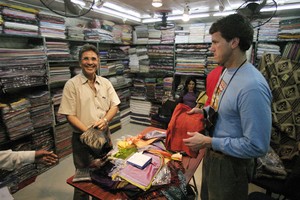
Guess who won?
Indians have founded more engineering and technology companies in the U.S. during the past decade than immigrants from Britain, China, Taiwan and Japan combined (Source: Where The Engineers Are, Vivek Wadhwa, 2007).
Incredible.
The entrepreneurial abilities of Indians in general has amazed me for years. It seems that Indian culture produces an uncommon blend of innovative thinking, business-minded aggression, and comfort with numbers. But there is another ingredient…
Two weeks ago, I saw a screening of the film 2 Million Minutes, a new comparative documentary that examines education in the US, China, and India. The filmmaker, Bob Compton, also wrote a book titled Blogging Through India, which I thumbed through before the movie.
Lo and behold, it contained this great little description on one of the greatest skills Indians bring to the table:
Negotiation.
###
In India, every transaction — EVERY transaction — is negotiated. Merchandise, cab fare, restaurant bills, wedding doweries — the list is endless.
As our guide Vishnu explained, “In India, we bargain to the level of the individual vegetable purchase.”
While awkward and uncomfortable to most Americans, that level of negotiating can be quite valuable.
Hotmail founder Sabeer Bhatia, a CA transplant from Bangalore, credited the bargaining skills he learned in vegetable markets at home for getting Microsoft to push its acquisition price for his company from $160 million to $400 million. Bill Gates’ eye teeth were floating in tea with that deal.
Here are a few rules for bargaining on the buy-side when in India…
Rule #1 – The true price of any item is what you pay — There are no suggested retail prices in India. Nothing is labeled, so it pays to talk with several vendors before making a significant purchase.
Rule # 2 – Try for 70% off — Don’t accept less than 30%
Rule # 3 – Make them show lots of merchandise — If it is a rug merchant, you want the demo guys sweating profusely before you make your first offer. Get the vendor to “invest” in the transaction — emotion, time and energy.
Rule # 4 – Offer on one item at a time — If you plan to buy a couple things DON’T let on at the outset. Act like you intend to buy only one item, if that much. Get the seller to give you prices on each item; play one item off another to show you are looking for the lower price point.
Rule # 5 – Wait for the pad of paper — Every Indian sales person has a pad of paper and a pencil that they pull out when the bargaining gets a bit more serious. Though they write down the price for an item, this is only the starting point – remember rule #2.
Rule # 6 – Say “TOO HIGH”, a lot — Don’t even start negotiating until the salesman has scratched through the initial price and lowered it at least twice. I found that simply staring in silence at the pad of paper for a long time would result in the vendor cutting the price.
Rule # 7 – Imply a bundled purchase — OK, now that the price has been cut 25-30%, ask the salesman what deal he would give you if you buy two items. Expect 5% off. Ask for three items; get another 5%. Then add a very expensive 4th item — one which you do not intend to buy. This will excite the vendor and he will do a bunch of calculations which you will be unable to follow. The price will come down for the expensive item as well as for the other items you intend to buy. Lock those prices and drop the expensive item.
At this point, you should have been able to shave close to 50% off the initial price. Most Americans generally are satisfied at this point and close the deal.
One final point – no matter what price you pay — if the sales guy is smiling when you leave — guess who won…
###
Is it a stereotype that Indians are good at negotiating? Sure. Is it accurate? Just neglect to prepare next time you match wits against an Indian entrepreneur and you tell me.
Do you have your own negotiating strategies, tips, or stories? If so, please share in the comments, and feel free to build on or borrow from the recommendations in the 4HWW.
If you’re interested in checking out 2 Million Minutes, which is provocative to say the least, the next screening is this Thursday, Dec 13 at 7:30pm in the 500-seat Varsity Theatre in Des Moines, IA:
1207 25th St
Des Moines, IA 50311
(515) 277-0404
Fans include Barack Obama. For free tickets, just call Meg Charlebois at 317-202-2280 ext. 11 or email her at Meg@dittoePR.com before Thursday at noon.

Comment Rules: Remember what Fonzie was like? Cool. That's how we're gonna be — cool. Critical is fine, but if you're rude, we'll delete your stuff. Please do not put your URL in the comment text and please use your PERSONAL name or initials and not your business name, as the latter comes off like spam. Have fun and thanks for adding to the conversation! (Thanks to Brian Oberkirch for the inspiration.)
I like to buy most of my items from places like second hand stores, phish lots and festivals, flea markets and small family owned businesses and the like, so negotiating is always how i handle the situation…stores and businesses in the US are usually owned by higher ups who are nowhere to be found, and the people selling the item have no say in the matter, but ive found that when they do, they are usually looking to move as much product as possible, regardless of the price. when i buy used music from a record store i can usually pick up $50-100 of merch, and walk out with half of it for a quarter of the price by negotiating a dropping the prices of the expensive triple disc items, then dropping the single items i dont need or can find anywhere
I have a store and hate people bargaining. Seriously, if they are not serious, please save my time and energy. My store is a bargaining store. My price is half of what they can buy out there. Sometimes I dont want to be offensive but when I see the people bargaining, I want them to go off and not have a deal with them. Seriously, if it is like a hotmail deal or a vehicle or a house, I can see the value in bargaining. But if it is like vegetable, why put so much effort into a few dollars???
As an Indian, I can say that not everything in this post is true. Most items in India are fixed priced these days. You will have no scope for negotiation in a good indoor shop. Even if you do, you will make yourself seem like a beggar. Bargaining culture exists only in small shops and street shops. Besides, most Indians who bargain too much are lower middle class people. I personally avoid bargaining as far as possible, simply because I find it cheap and irritating. When I do sometimes, it is fun though. But again, most Indian street shopkeepers will ask for prices 5 times the original product price. So if you are on the streets messing around with those shops, go ahead and bargain. However, if you are in a reputable store, please behave and avoid bargaining. Everything has a limit, don't be shameless.
I am Indian and the fact that people feel the need to negotiate is quite sad. It tells that people don't trust each other and everyone is trying to rip off each other. When more people try to negotiate or bargain, there is lot of pressure on seller and it is more likely the seller is going to cheat and sell you a fake or overprice the item to begin with. In end no body really wins, but both parties lose time haggling and also health by exposing them to higher levels of stress. My strategy is simple if I like the price and product I buy it, else simply walk away without bargaining. This just requires one to research the product well and be a good judge of quality. With time you learn which businessmen are honest and they value you as a good customer and take good care of you. Therefore I also look for recommendations from friends and family members. It is also another common Indian trait, perhaps something worth more appreciation than the art of negotiation.
Hello I work for an educational publishing company based in the UK which publishes material for students of English as a Foreign Language. We are currently preparing a title for publication in spring next year, and our author would like to use extracts from this article to form a text to appear in one of the units. Can you let me know whether or not this would this be possible? Our text is 330 words long, most of which are directly quoted from the article, with some information omitted or reworded for ease of comprehension etc. as the intended readers are not native English speakers. There will be some comprehension questions about the passage and the language used. I would be happy to send you a copy of the text, and to provide a copy of the unit where this would appear if you wish. I would appreciate it if someone could email me about this to let me know how to proceed. Many thanks Rachel
I find it so hard to negotiate or haggle with people, I just suck at it… But I'll try and take your advice on board, Indians are masters of the haggle.
I got so sick of this haggling that I will no longer give any discounts whatsoever when Indians start with this routine. It's fine to ask once. When you hear the same damn question 10 times it gets old really quickly. You give me best price? You give me free delivery? No tax? I pay cash you give to me cheaper? I have friend who needs very much furniture, I tell him to come to your store. So now you give me best price??? Free delivery? No tax? Best price? It's exhausting to the point where I no longer put up with it.
I believe that negotiating really doesn't help us Indians.. as it is an utter waste of time… The westerners do it right… As they would just research the whole market and then look for the product with the right price, go and buy it. Doing so they, leave a tight noose around the neck of sellers, such that if they don't correct their retail price they would defnitely end up on the wrong side, killing their own business and then themselves in the end. My call would be just to give your price for the product if the seller is not willing to give in leave it else buy it. I bet people from western countries know that what goes around comes around. So, they know in case to get the best of the quality they need to pay for it. This is the reson why they have high per capita income and better quality products. Moreover, Negotiating is really complex and depends on both buyers and sellers response to a deal. So if both quote the right price there wont be much of time wasted & the same time could be utilised to be more progressive and could be utilised on other important chores.
Good advice. Negotiating is about belief. A good belief to have is: "Everything is negotiable."
Ok thats fine and dandy and makes alot of sense when applied to Indians from India. What about the Indian fellow that has never been to India, and has been brought up in a westernized civilization. Whose father and grandfather were born out of India. . . Is he not blessed with these super powers of negotiation? Let us not forget our European counterparts, the portugese, the spanish and italian, who constantly strive for bargains and are allot more aggressive when doing so. The art of negotiation stems from a sufficiently accurate perception of human behavior and a complete understanding of business principles.
Very funny and educative. Learned a few points here 🙂
Interested to see that, even in the final words of this article the mindset is unable to move away from negotiation as having a winner and a loser.
you mean "How to Haggle like a PITA" you should see how (most) transplanted Indians do the same "negotiation" in the west. It's almost like they believe they can tire out the vendor into giving up and just give it to them. Check out Russel Peters comical interpretation.
Negotiating to the point that Indians do is not only wearing, but downright unnecessary. Learn to enjoy life instead of being trivial and a cheapskate. Indians should learn to be less irritating in general when it comes to money.
I'd rather have a slightly lower paycheck than deal with a Patel at work…
Can you imagine a world where all people negotiated like Indians and Jewish merchants? It would resemble the 7th circle of Hades.
This sounds so Third World. Haggling may seem to be a forgotten art form here in the states, but there is a reason for that. If you have to tear someone down before you buy their stuff then you may wake up one day and find that you have no friends, as you've negotiated them all away, one complaint at a time. I recommend that you decide how much it's worth to you to own the item and then offer that much if it's less than the asking price. If they don't want to sell it for that, then don't buy it. Much less wear and tear. Life is not a bargaining contest or for who has the most toys.
lol, I am an Indian, and I never bargained like that. Huge country, you can't put a tag like that. 🙂
Depends where you do. The author hasn't apparently done a proper research. Call it biased sampling
Indians are not excellent at negotiating, they are just CHEAP. The main rule is that they won't make a purchase unless the price is at least 30% below the fair market value of what they are trying to buy. The worst part is that wasting your time is part of the strategy. Additionally, efforts to convince you that such drastically low ball offer somehow is exceptionally great for you are insulting seller's intelligence.
This is very informative. Appreciate your effort in sharing such useful info. Will try to negotiate better now 🙂
that's all great advice and I agree with you after being in the Navy and traveling the world you're very right and knowledgeable but I want to know how to deal with the Indian that's here in America how to bargain with them in their stores
good but at the fourth no. you said that offer on one item at time i am not agree this, if we look for more thing at one time then salesmen will have pressure that he/she will loose his/ her costumer And one point i want to add always ready to leave
From rule number 2, I'd gather that as soon as you know you are dealing with an Indian, raise your price 30%, especially if you have a unique or premium product. You get a price that allows you to make a profit, and they get the satisfaction of talking you down. Everyone's happy. And if they say "Too high. Too high," respond "Too low. Too low."
It is funny how the countries where buyers engage in extensive negotiations over a single vegetable, or a piece of gum, just happen to be impoverished as a general rule. It is extremely inefficient to deal with people who never consider a deal done. Not all Indians are obsessive bargainers.
Very nice. Do you have a blog for sellers dealing with buyers negotiating from the Indian culture?
I'm an attorney and every Indian that has ever called me (maybe 25 over the years) pretends to be looking to hire me but is just trying to get free advice. Every, single, one. I try not to be too rude and just move them along without wasting too much of my time – but they just keep coming back trying to get me to give them free advice. There are cheap cultures and there are just dishonest cultures. This isn't admirable – it's pathetic and embarrassing.
America shouldn't be treated like a third world country we don't haggle prices everything is set in stone unless otherwise noted
I found the article very interesting (and the comments), though I would take issue with one thing. The article gives the impression the vendor has 'won' and you have 'lost' if they are still smiling when you leave. In my opinion, you should BOTH be smiling when you leave. Unless it is win/win for both of you, it is not a good transaction! We as buyers should not be out to make the vendor suffer, but to get the best deal for both of us. That way, the vendor stays in business and we can deal with them again. It's called building good business relationships, IMHO!
I tried this in the local Indian restaurant and they called the police!
this is how a bargain with an auto driver( tuk tuk driver) I ask him first to quote his price . then I quote him the price which is generally 1/4th the initial price he has quoted and at the end of the bargain he has halved the price.
7 Rules are not enough to learn tactics of negotiations like Indians. you have to become one to learn these things.
You try to negotiate in my shop, I ask you to leave. I just recently had an Indian guy ask me to give him a discount and I said for what? Why should I give you a discount? If you don't like my price, go somewhere else but I know you will be back because I already have the lowest prices. I hate people who always want a discount for no good reason. I need to eat too, quit being a cheapskate and either pay my price or get out.
Great information within on how silence can be your best friend. If someone is still talking during the transaction, it’s usually the immature buyer who is talking themselves out of a lower price.
Two observations: One, "bargaining" is different from "negotiating". Bargaining is trying to get a lower price as a buyer. Generally, the seller can't raise the price once stated. Negotiating is an exchange of value, which can be a very etherial thing: time vs. cash vs. intellectual property for example. Two, if one begins with the notion that there's a winner and a loser in a transaction will get one emotionally involved and overlook better terms in order to avoid being (self) labeled a "loser". Also, in negotiating, one must decide – going into the negotiation – whether or not you will ever be negotiating with this person or organization again. If there is any chance of a future negotiation, one must be prepared to "leave something on the table", so that the other party believes they have gained from negotiating with you and will look forward to future positive transactions. This is often (now cliched) called, "win-win". If not, get as much as you can regardless of the economic/emotional impact left behind. Lastly, Pareto applies: 80/20. 80% of what you accomplish comes from 20% of your efforts. Focus on the 20% and negotiate hard; forget the 80% that yields 20% of the result. You are wasting your valuable time, and resources.
Negotiation has to be open ended. This is a interesting read.
We're missing the fact that here in India, the shopkeepers and the sellers themselves start off with a high price. They've evolved with the bargaining times, and now, if someone doesn't bargain with the vegetable-wala, it's a real miracle. They start their prices off with three hundred rupees for something that costs one hundred and fifty rupees. And then we argue and being down the price to two hundred rupees. So, in the end, we're functioning as a win-win situation without the buyer's knowledge most of the time. Also, here's another tip for bargaining: if the seller seems really eager for you to make a purchase but refuses to lower the price, wall out of the store. They'll tell out their lowest possible price as you walk out in desperation, and then you can enter back. This is only if the seller seems desperate to make a deal. I usually don't like to resort to this, because it makes me feel terrible afterward that I, who can afford to spare a few extra fifty rupees', am fighting for the lowest price with a seller that is so desperate for the money. But in practicality, this usuallly is very useful.
How to negotiate like indian is very interesting article.
There's bargaining and then … there's negotiation. Bargaining is basically haggling on price using different ploys such as quantity, competition, walking-away, agreeing to a price on a higher quantity and then taking a lesser quantity for the same price. It is a practice that consumes a great deal of time & energy with mixed results. Negotiating is more give-and-take where both sides discuss their resources and goals and attempt to exchange things of lesser value to one side for things of more value held by the other side. For example, I'm a contractor with a slack schedule; I have idle staff, but don't want to lay them off because I won't get them back. So being able to expedite a job would take something of a lesser value (wages for no work) and offer it to someone who values time greatly … they need it done sooner than later. In return, they offer something of a lesser value – additional funds – for something of greater value to them – the job done NOW! The reverse also works – someone who wants a job done, but isn't in any rush, and a contractor who is very booked NOW, but wants a pipeline of work for the future. The homeowner gets the work for less and the contractor gets additional work he/she would had to have passed on. Another example would be a hotel or airline faced with an empty room or seat, but sells it at a discount to a last-minute traveler. The traveler is less concerned with the time factor (traveling at a specific time) than getting the accommodation at a reduced price. The key is BOTH sides communicating openly … or at least somewhat openly … about what is important vs. less important. BOTH side benefit, the job gets done and no one is wondering who won and who lost. Best negotiating advice: move away from bargaining and toward negotiating. Bargain the small items, but your biggest gains will come from negotiating the big items.
I have been searching for the last 16 hours for an article like yours and the possibility of being able to reach out to someone about my current situation. i recently made the decision to purchase all the inventory of a local head shop. [Moderator: name removed.] the owner of 50 years has had a stroke and has decided to sell all his merchandise. The building that he owns will be renovated to house his three children who have become lawyers. we negotiate and negotiate and finally agree. ( im the fool no paperwork signed) at this point he loves me and my business partner. we are his daughters, good girls….etc. we agree on price half cash and half draft. _ first a deposit $7.000. _draft for 25,000 _finally 18,000 in cash we have been packing for 3 weeks. … he comes in everyday from the beginning he has been taking things that i have photos of a blue felt roll jewelry case full of gold chains. but its missing. 'ooh dear i don't know' says [Moderator: name removed.]. swords on the wall there were three. next day only one left. yes we must compromise my sons wanted one. Brass vases, large elephants in black brass which i have fought for and somehow he agreed with me. but i did not know to take it out of store immediately. H decided its his and its gone. when i negotiate hard and win he threatens actually calls to have locks on doors changed. remember i have foolishly no paperwork to prove sale. although he has told everyone. that explains the lay of the land with this business transaction. BUT NOW HE WANTS ANOTHER DRAFT FOR THE HST ON JUST THE 25000. What! when did that come up. i say no he says his store he will change lock. So i have not spoken to him in the last week. i am very cold in his presence. my business partner and my son they are kissing his ass. last note whe found 30 grams of gold in the merchandise so [Moderator: woman's name removed.] said we can pay him with that. All marked 14 k….worth 4,500.00…. all fake. i do not want to pay him this. can i make a fake draft. can i give him his gold back. and say here its worth. 45 hundred. how can i hold him off until the movers are done in two days. I am so furious with him for stealing merchandise we have already paid for daily. and now he wants oh yes the hst but just on half ….cause he won't show the other 25000 he received in cash. Any way to win this point. Very upset but my hands are tied. suggestions please MAHP
Guideline on when to start antiretroviral therapy and on pre-exposure prophylaxis for HIV'
Hey @ Tim Ferriss Haha…Just Love The way You Express such topic in this Post. I’m Huge fan of Your work ,So much I linked you to my Website. [Moderator: links and handles removed.] Cheers . . Team Gehna . . [Moderator: additional text removed.]
Great advice. In my experience, the one area it does not work; INSURANCE. I sell Liability, Commercial Property and Workmans Comp for Assisted Living Facilities in California. This industry is largely operated by foreigners who try these tactics on me, after I have done my due diligence to find the best rate for them. Often the potential customer is too stubborn when I tell them this is the lowest rate, they shop elsewhere and end up paying a few hundred dollars more merely out of pride.
I have certainly become aware of this cultural trate of the many Indian families who call for my particular service. It all makes more sense after reading this article. As it happens, I have a very reliable formula for pricing my product and I simply never negotiate. I will often be confronted with multiple attempts to cut the cost. Even during and at the end of a job whose price was fully expressed at the time of scheduling. I have been asked for discounts on top of discounts. Like a lower price and then asked how about if it's cash and can I cancel the sales tax then. That's the somewhat more rare triple discount! In the end I explain that my service is priced accurately and well worth the cost. I offer that my intention is to treat every customer as an equal. They usually understand my position at that point and continue to ask if there are any promotions or discounts available. They're unbelievable. I will also say that once in their home, they are quite gracious. It is uncommon if there isn't at least one pair of elder parents living in the home. They will attempt to speak English and offer food and drink. One gentleman gave me a bag of fruit for my family. There is always a room with a shrine, and often someone kneeling in prayer even as I work in the same room. Do not attempt to werar shoes in their home. Booties or stocking feet are a must. It is common for the home owner to follow me and watch while I'm working. Apparently, in India, you can't necessarily trust a workman to be honest and they will come off as suspicious at times. It is also common for them to meet me outside at my truck and want to pay me there. It is not expected that I would re enter the home once work is completed. You gotta laugh.
Instead of suggesting/acting out all such low-moral ideas – pay the price and hope to be blessed
As an Indian. This is true. I’ve watched my dad do it and others in my family work people to get a ‘deal’. What I’ve observed talking to my friends who are not India. Is that when people work with Indians on a sale, they’ll mark the price higher. Knowing that the Indian will negotiate down or they will 1/2 ass the work and claim it to be top quality. Electricians, plumbers, HVAC, home remodeling etc, these tradesmen have been burned by many Indians to the point where they increase prices so that the Indian prospect doesn’t choose them or they cut corners just to make a quick buck. This behavior is draining of energy, time and financial resources on the part of the tradesman. Indians seem not to care. When I need personal work on my home doing. I ask my wife who is Mexican American or my white brother in law to take the bids. I know for a fact, if I was there, my quotes are higher. Indians are screwing themselves over and ruining it for the rest of us who want the jobs done right at a fair price.
The answer to that is simple. Tell them to go somewhere else.